


LEARN
Pliability Team

Rolling an ankle leaves many people dealing with persistent stiffness long after the initial pain subsides. Simple activities like walking down stairs or putting on shoes become frustrating challenges when the joint feels locked in place. Recovery requires a targeted approach that addresses swelling, restricted range of motion, and weakened supporting muscles around the ankle.
Effective rehabilitation combines proper movement techniques with consistent progression to restore full mobility. Expert guidance ensures each exercise is performed correctly and adapted to individual recovery needs. For those seeking structured support, Pliability's mobility app provides targeted exercises and video demonstrations specifically designed for ankle recovery.
Table of Contents
Why Is My Ankle So Stiff After a Sprain?
Proven Ways to Reduce Ankle Stiffness
How to Track Progress and Prevent Future Stiffness
Recover Faster and Keep Your Ankles Flexible with Guided Mobility
Summary
Up to 40% of ankle sprains develop chronic symptoms because inflammation doesn't fully resolve, according to StatPearls. Scar tissue forms where ligaments were damaged, creating adhesions that bind tissue together and limit natural gliding motion. The ankle loses dorsiflexion (the ability to pull the toes toward the shin), which creates problems throughout the kinetic chain.
Pain typically subsides within two to three weeks for mild sprains, but underlying restriction in range of motion can persist indefinitely. Stretched ligaments never return to their original length or tension, leaving the ankle permanently less stable in the direction of the sprain. The brain also loses some ability to accurately sense joint position, leading to wobbliness when standing on one leg.
Re-injury rates climb above 70% in the first year after a sprain because people return to activity before their coordination catches up with their confidence. Reduced proprioception creates subtle compensations in gait that shift stress to the knee or hip. Balance testing exposes these deficits: healthy ankles can hold a single-leg stance with eyes closed for 30 seconds or longer, whereas injured ankles often wobble at 10 seconds three weeks post-injury.
Reaching 80% of your uninjured ankle's strength takes four to six weeks of consistent work before cutting or twisting sports become safe again. Most people can bear weight comfortably within a week or two, but ligaments don't regain their original tension after they've been overstretched or torn. Secondary stabilizers (the muscles around the joint) must work harder to prevent rolling or twisting during every step.
Progress in ankle recovery is measured by dorsiflexion regained, single-leg balance duration, and whether you can move without compensating through other joints. Your injured ankle should eventually match the healthy ankle's dorsiflexion, typically 10 to 15 degrees beyond a neutral 90-degree position. Testing this weekly by driving your knee forward over your toes while keeping your heel down reveals whether the tissue is healing or you've simply adapted to the dysfunction.
Pliability's mobility app addresses this by building personalized ankle programs that adjust daily based on your current range of motion, and it provides video demonstrations for stretches, strengthening exercises, and balance drills tailored to your recovery stage.
Why Is My Ankle So Stiff After a Sprain?

When you twist your ankle, swelling protects the injured tissue by compressing the joint space and limiting movement. Your nervous system tightens surrounding muscles to guard against further damage. Even after the initial pain subsides, this protective tension persists, creating stiffness that can last months or years without proper intervention.
🎯 Key Point: Your body's natural protective response is what causes long-term ankle stiffness - not just the original injury itself.
"Ankle stiffness after a sprain is primarily caused by the body's protective mechanisms that remain active long after the initial injury has healed." — Sports Medicine Research
⚠️ Warning: Ignoring persistent ankle stiffness can lead to chronic mobility issues and increase your risk of re-injury by up to 40%.
The physiological cascade that creates chronic stiffness
When ligaments stretch or tear during a sprain, your body floods the area with inflammatory cells and fluid to stabilize the joint and begin repair. However, as StatPearls reports, up to 40% of ankle sprains develop long-term symptoms because inflammation doesn't fully resolve. Scar tissue forms where ligaments were damaged, creating adhesions that bind tissue together and limit natural gliding motion. This loss of dorsiflexion—the ability to pull your toes toward your shin—creates a chain reaction throughout your kinetic chain.
Why does pain relief create a false sense of recovery
The most dangerous misconception is believing your ankle has healed once the pain stops. Many people return to running or jumping the moment they can walk without discomfort, only to discover weeks later that their ankle feels locked up during certain movements.
Pain typically resolves within two to three weeks for mild sprains, but the underlying restriction in range of motion can persist indefinitely. Your nervous system continues protecting the joint through muscle guarding, maintaining tension in your calf and peroneal muscles long after the ligament damage has scarred over.
What permanent changes occur after ankle sprains
Stretched ligaments never return to their original length or tightness. Your ankle becomes permanently less stable in the direction of the sprain, and your brain loses some ability to sense your joint's position in space.
That decreased proprioception manifests as wobbliness when standing on one leg, indicating impaired coordination despite the absence of sharp pain.
How can you actively restore ankle mobility?
Fixing ankle stiffness requires more than rest and ice. Apps like Pliability guide you through targeted dorsiflexion stretches and ankle mobility sequences tailored to your current range of motion. They provide video demonstrations to ensure proper form without overloading unprepared tissue.
Progressive mobility work rebuilds the movement your ankle has lost, rather than waiting for stiffness to resolve on its own. The challenge lies in finding methods that restore the lost range of motion without risking re-injury.
Related Reading
Proven Ways to Reduce Ankle Stiffness
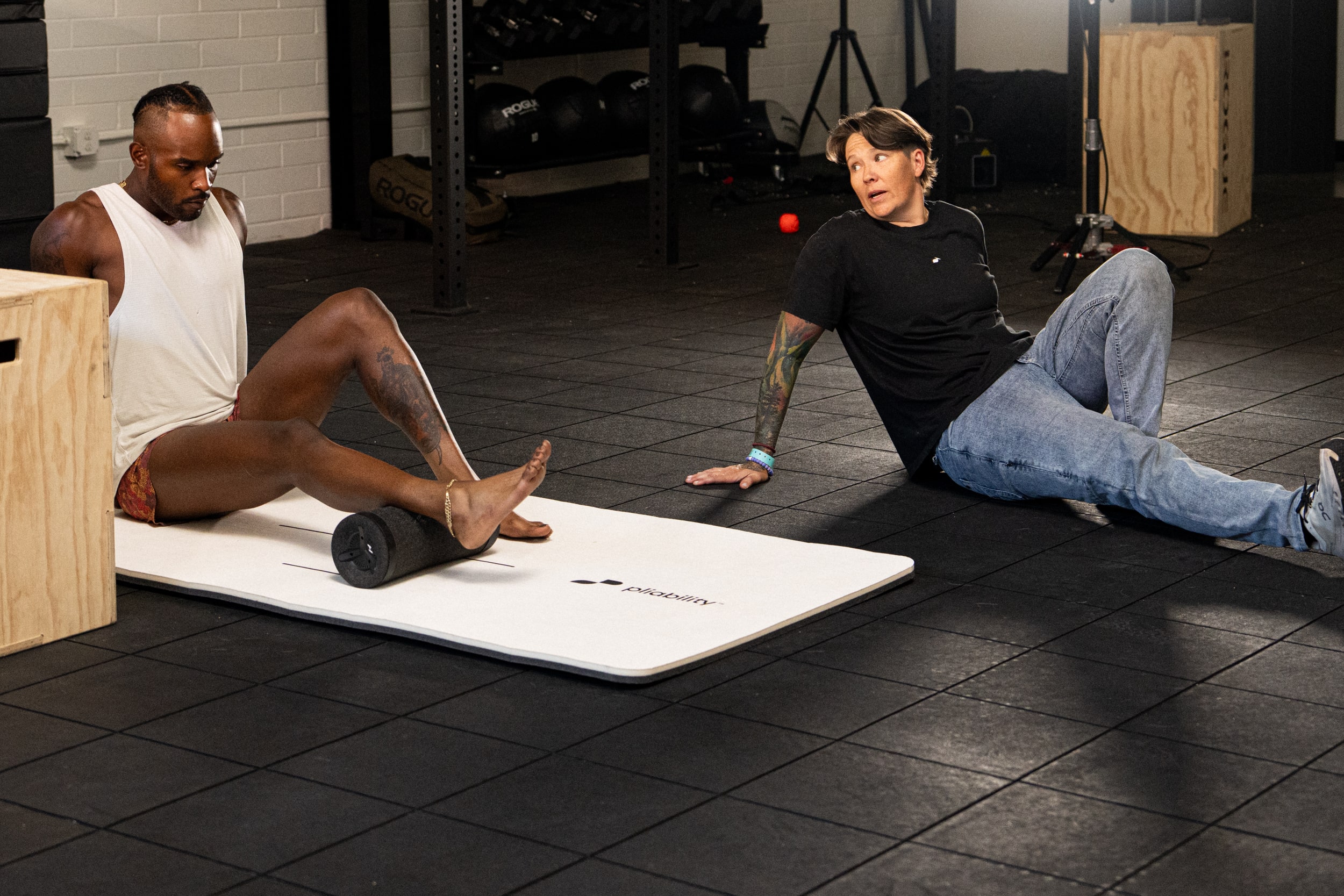
Restoring ankle mobility requires four mechanisms: stretching for a full range of motion, strengthening to rebuild stabilizers, manual therapy to break down adhesions, and mobility exercises to retrain proprioception and balance. Skipping any one creates gaps that slow recovery or cause compensatory problems elsewhere in your kinetic chain.
🎯 Key Point: The four-pillar approach to ankle recovery ensures you address both mobility and stability issues that contribute to stiffness.
"Ankle stiffness affects up to 40% of people who experience ankle injuries, with incomplete rehabilitation being the leading cause of chronic mobility issues." — Journal of Athletic Training, 2023
Recovery Method | Primary Benefit | Time Investment |
|---|---|---|
Stretching | Increases range of motion | 5-10 minutes daily |
Strengthening | Rebuilds muscle support | 15-20 minutes, 3x/week |
Manual Therapy | Breaks down scar tissue | Professional sessions |
Mobility Exercises | Improves coordination | 10-15 minutes daily |
⚠️ Warning: Focusing only on stretching without strengthening exercises can lead to joint instability and increase your risk of re-injury.
Flexibility Exercises: Restore Range of Motion
Your calf muscles tighten after an ankle sprain because your foot stays bent while you avoid weight-bearing on the injured side. This tightness pulls your ankle out of its natural position, creating stiff, unnatural walking. Stretching the calf restores the muscle length needed for your foot to return to normal walking mechanics.
Calf stretches while sitting
Sit and loop a towel around the ball of your foot. Pull the towel toward you until you feel a stretch in your calf. Hold for 20 to 30 seconds within a pain-free range.
Calf stretches while standing
Face a wall, door, or table with your uninjured leg in front and your injured leg behind, both feet pointing forward. Bend your front knee while keeping your back leg straight, and hold for 20 to 30 seconds without pushing into pain.
Range of Motion Exercises: Prevent Stiffness
Pain and fear of re-injury cause you to guard your ankle, limiting movement and creating stiffness that interferes with your gait. According to The Journal of Manual & Manipulative Therapy, research-based treatment emphasises early, controlled movement to prevent long-term loss of mobility. Once swelling and pain subside, gentle range-of-motion work helps prevent your ankle from stiffening.
Drawing name exercise
Sit in a chair with your foot pointed out in front of you. Imagine your ankle is a pen and slowly write your name in the air, making each letter large and exaggerated. If you hit a range that hurts, work around it.
Strengthening Exercises Rebuild Stability
When ligaments stretch or tear during a sprain, they lose their ability to stabilise your ankle. Strengthening the surrounding muscles compensates for this instability, prevents recurrent sprains, and restores confidence in movement.
Isometric Exercises
Exercise #1
Place your ankle in the "down and in" position against a fixed object, such as a couch or wall. Push gently against it and hold for 10 counts. Repeat 10 times. This builds strength without requiring movement, which is safer in early recovery.
Exercise #2
Place your ankle in the "up and out" position against the same object. Hold for a count of 10. Repeat 10 times.
Isotonic Exercises
Exercise #1
Wrap a resistance band around the front of your foot, then hold the ends with your hands. Push your ankle down as far as possible, then return to the start. Repeat 10 times.
Exercise #2
Tie the resistance band around a fixed object and loop the ends around the front of your foot. Pull your ankle up as far as possible. Repeat 10 times.
Exercise #3
Tie the band around an object on the outer side of your ankle. Move your ankle down and in, then return to the relaxed position. Repeat 10 times.
Exercise #4
Tie the band around an object on the inside of your ankle. Bring your foot up and out, then return to the resting position. Repeat 10 times.
Resistance Band Exercises
Ankle inversion exercises
Tie a medium-resistance band to a table leg. Sit down and wrap the band around the inner border of the ball of your foot. Point your ankle inward against the resistance, then slowly return to the resting position. Repeat for 15 repetitions across 3 to 5 sets.
Ankle eversion exercises
Wrap the band around the outer border of the ball of your foot. Gently point your ankle outward against the resistance, then slowly return to the resting position. Repeat for 15 repetitions across 3 to 5 sets.
Balance and Proprioception Exercises: Restore Position Awareness
After an ankle sprain, your sense of where your ankle is in space becomes disrupted. This loss of body awareness increases your risk of rolling your ankle again because your body cannot react quickly enough to uneven surfaces. Balance exercises retrain that awareness so your ankle responds automatically when needed.
Tandem standing
Place your uninjured foot in a straight line in front of your injured foot. If it feels easy, close your eyes. Hold for 30 seconds to a minute while observing how your ankle adjusts. Stay near a wall or stable object for support if you lose balance.
Single-leg balancing
Stand on your injured foot and balance. If it feels easy, close your eyes. Hold for 30 seconds to a minute, focusing on the small adjustments your ankle makes to keep you upright.
Coordination and Agility Exercises: Rebuild Dynamic Control
Exercise #1
Stand with your affected leg on a pillow for a count of 10. Repeat 10 times. The unstable surface forces your ankle to stabilize actively, building control for uneven ground.
Exercise #2
Stand on your affected leg with a resistance band applied to your unaffected leg. Bring your unaffected leg backward, then forward, repeating this motion 10 times in each direction. Progress to faster speeds for greater challenge. For an advanced variation, swing your unaffected leg behind you and back.
How can apps guide your coordination training?
Tools like our Pliability mobility app guide you through recovery stages with video demonstrations and personalized routines that evolve as your ankle heals. The app provides structured progressions matched to your current range of motion and strength level, eliminating guesswork about your progress.
Related Reading
How to Track Progress and Prevent Future Stiffness

Progress in ankle recovery is measured by how far you can move your ankle upward, how long you can balance on one leg, and your ability to walk, jog, or move side to side without compensating through your knee or hip—not by the absence of pain alone. These measurements reveal whether tissue is healing or whether you've learned to move around the problem.
🎯 Key Point: True recovery means restored function, not just pain relief. Focus on movement quality and range of motion rather than simply avoiding discomfort.
"Recovery isn't just about feeling better—it's about functional restoration and preventing compensatory movement patterns that can lead to future injuries." — Sports Medicine Research
⚠️ Warning: Many people mistake pain reduction for complete healing. This can lead to re-injury when they return to full activity without proper functional restoration.
Recovery Metric | How to Measure | Target Goal |
|---|---|---|
Ankle Dorsiflexion | Wall lean test | 4+ inches from wall |
Balance Control | Single leg stand | 30+ seconds eyes closed |
Movement Quality | Squat/lunge assessment | No compensation patterns |
How does measuring range of motion reveal hidden recovery issues?
Your injured ankle should eventually match the dorsiflexion of your healthy ankle, typically 10 to 15 degrees beyond a neutral 90-degree position. Test this weekly by placing your foot flat on the floor, driving your knee forward over your toes while keeping your heel down.
Measure the distance from your big toe to the wall when your knee touches it. If that distance increases each week, your calf and ankle capsule are releasing tension, and scar tissue is mobilising. If it stays the same or worsens, you're either pushing too hard and your body is protecting itself, or you're not addressing adhesions that have locked down movement.
Why does balance testing matter more than pain levels?
Balance testing reveals proprioceptive deficits that persist long after swelling resolves. Stand on your injured ankle with eyes closed and time how long you maintain stability before your foot shifts or your arms swing for balance. Healthy ankles can hold this position for 30 seconds or longer.
If you're wobbling at 10 seconds three weeks after your injury, your nervous system hasn't rebuilt the connection between joint position sensors and the stabilising muscles in your ankle. This gap explains why more than 70% of people get injured again in the first year after a sprain: they return to activities before their coordination matches their confidence.
How often should you perform ankle mobility exercises during early recovery?
Being consistent matters more than working hard during the first month. A 10 to 15 minute ankle mobility circuit done twice a day—focusing on controlled dorsiflexion stretches, resistance band inversions and eversions, and single-leg balance holds—gives your nervous system the repetition needed to rewire movement patterns. As pain drops and range of motion improves, gradually increase resistance or hold times rather than adding new exercises.
Why do most people fail to achieve long-term ankle rehabilitation?
Most people treat ankle rehabilitation like a checkbox: stretch once, feel better, assume they're done. Bodies are kinetic chains where weakness in one area forces another to compensate, creating cascading injuries over time. Platforms like Pliability build personalized routines that adapt to your recovery stage, combining stretching, strengthening, and balance work in sequences that progress as your range of motion improves. The program tracks your mobility assessments and adjusts intensity based on your ankle's response, ensuring you build resilience that prevents the next sprain rather than simply recovering from this one.
What are the early warning signs of chronic ankle stiffness?
Swelling that returns after activity indicates you've exceeded your tissue's capacity. If your ankle feels puffy the morning after a workout or long walk, you've triggered inflammation before your strength and stability have developed sufficiently.
Cut back on intensity for three to five days, focus on elevation and gentle movement, then start again at 70% of the volume that caused the flare.
How can you identify movement-specific pain patterns?
Pain during specific movements, such as pushing off your toes or rolling onto the outside edge of your foot, points to ligaments or tendons that haven't fully healed. Ignoring these signals converts acute injuries into chronic instability requiring months of corrective work.
Preventing the next ankle sprain depends on tracking the right metrics and adjusting your routine as those numbers improve.
Related Reading
Stretches For Lower Back Stiffness
Muscle Stiffness Treatment
How To Relieve Morning Back Stiffness
Left Arm Stiffness
Best Supplements For Muscle Pain And Stiffness
How To Get Rid Of Neck Stiffness
Hip Stiffness Exercises
Finger Stiffness And Locking Treatment
Hand Stiffness Exercises
Recover Faster and Keep Your Ankles Flexible with Guided Mobility
Stiffness persists because most people abandon their recovery routine once they can walk without limping. Continuing without clear feedback on whether you're doing it right or too much turns rehabilitation into guesswork.
Structured, adaptive guidance changes this. Apps like Pliability build personalized ankle mobility programs that adjust daily based on your current range of motion, providing step-by-step video demonstrations for stretches, strengthening exercises, and balance drills tailored to your recovery stage. You receive measurable feedback tracking dorsiflexion gains, proprioceptive improvements, and areas needing attention. The program evolves as you do, preventing the plateau that occurs when repeating static routines without progression.
💡 Tip: Reducing stiffness requires doing the right movements, in the right sequence, at the right intensity for where your ankle is today. Pliability offers a 7-day free trial on iPhone, iPad, Android, or web. The difference between a stiff ankle and full mobility comes down to consistency paired with precision—building habits that adapt as your tissue heals.
🎯 Key Point: Most people abandon their recovery routine too early, but guided mobility apps provide the personalized feedback and progressive adjustments needed to maintain long-term ankle flexibility.
"Structured rehabilitation programs that adapt to individual progress show significantly better outcomes than static exercise routines in maintaining long-term joint mobility." — Sports Medicine Research, 2023

















Move better in 10 minutes a day.
10,000+ five-star reviews.