


LEARN
Pliability Team
Knee stiffness after running affects countless runners, from beginners to experienced athletes, often signaling that something in training, recovery, or movement patterns needs attention. That tight, achy feeling hours after a run typically stems from muscle imbalances, poor mobility, or inadequate recovery practices. Understanding the root causes helps runners address the issue effectively rather than simply enduring the discomfort.
Targeted recovery routines can restore the range of motion and strengthen the muscles supporting the knees. Addressing common contributors such as tight quadriceps, weak glutes, or limited ankle mobility can transform post-run stiffness into smooth, comfortable movement. For personalized guidance through specific movements designed to reduce inflammation and restore mobility, runners can benefit from using a mobility app that targets these underlying issues.
Table of Contents
Knee Stiffness After Running Isn’t “Normal” — It’s a Load Management Problem
Why Your Knees Feel Stiff After Running (The Biomechanics Most Runners Miss)
How to Reduce Knee Stiffness After Running (A Simple Recovery Test)
Knee Stiffness After Running? Improve Your Mobility in Minutes
Summary
Studies estimate that 30 to 50 percent of running injuries involve the knee, and stiffness often shows up weeks before pain forces you to stop. That gap between the first warning and the actual breakdown is where most runners lose time. They keep running through it, assuming soreness is normal, until something more serious develops.
Your knee absorbs between two and three times your body weight with every stride. Over a five-mile run at roughly 8,000 steps, that's more than 16,000 bodyweight impacts traveling through the joint. Stiffness shows up when three systems that normally share this load stop working efficiently together: your quadriceps lose their ability to absorb shock, your hips fail to stabilize the leg, and joint circulation slows after you stop moving.
Stiffness that resolves within 12 to 24 hours means your body handled the load. When stiffness lingers beyond 24 hours, or when you can't fully straighten or bend your knee the next day, the joint is signaling that it's carrying too much of the load. These are measurable thresholds that separate normal soreness from early-stage breakdown.
According to research cited by physical therapy clinics, 50% of runners experience knee pain at some point. Most of that pain starts as stiffness that persists longer than it should have. The gap between the first warning and the actual injury is where most runners lose weeks or months of training.
Gradual mileage increases prevent your body from absorbing more stress than it can recover from. Jumping weekly volume by more than 10 percent doesn't give connective tissue time to adapt. Tendons and ligaments remodel slowly. When you outpace tissue adaptation, stiffness is the first sign that recovery isn't keeping up with demand.
Pliability's mobility app addresses this by providing structured routines that target tight hip flexors, weak glutes, and restricted ankle mobility, the exact areas that determine whether your knee distributes load efficiently or takes on too much force.
Knee Stiffness After Running Isn’t “Normal” — It’s a Load Management Problem
Many runners assume knee stiffness after a run means they worked hard. But stiffness lasting longer than a few hours isn't tiredness—it's a clear sign that your knee joint absorbed more force than the surrounding muscles could distribute.
Studies show that 30 to 50 percent of running injuries involve the knee, and stiffness often shows up weeks before pain makes you stop. That critical gap between the first warning sign and when things break down is where most runners waste valuable time, continuing to run through it until something worse happens.
🔑 Key Takeaway: Knee stiffness lasting more than a few hours post-run is your body's early warning system - not a badge of honor.
⚠️ Warning: Ignoring persistent stiffness can lead to serious injury that sidelines you for weeks or months.
"30 to 50 percent of running injuries involve the knee, and stiffness often shows up weeks before pain makes runners stop." — Physiopedia Running Biomechanics Research
Why does running culture encourage pushing through discomfort?
Running culture rewards toughness. Training plans push weekly mileage increases, and rest days feel like lost progress. When your knees feel stiff the morning after a long run, it's easy to blame it on hard work and assume it will resolve by tomorrow.
What happens when stiffness persists beyond normal recovery?
Stiffness lasting more than 24 hours isn't delayed onset muscle soreness. It's often the knee joint compensating for muscles that can't handle impact well. When your quadriceps are tight, your glutes are inactive, or your calves are overworked, force doesn't spread evenly. The knee absorbs a load it wasn't designed to handle on its own.
How does chronic knee stiffness progress over time?
One runner described it as feeling like a 90-year-old at age 30. Mornings became a test, and stairs turned into a slow, deliberate process. What started as mild soreness after playing five days a week became hot, swollen knees that forced a cutback to once a week. The stiffness signalled how force was moving through the joint.
How does force travel through your body during running?
Every time your foot hits the ground, force travels up through your ankle, knee, and hip. Most runners take between 160 and 180 steps per minute, generating roughly 7,000 to 9,000 impacts over a five-mile run. Each one sends a wave of force through the knee joint.
What happens when muscles can't handle the impact?
When muscles around the knee absorb and distribute force well, the joint stays stable. When they don't, the cartilage, ligaments, and meniscus bear the brunt of the excess stress. Over time, that imbalance manifests as stiffness, reduced range of motion, or difficulty fully bending and straightening the leg.
The meniscus acts as a shock absorber between the femur and tibia. Repetitive stress and aging make it prone to degeneration and tearing. Ligaments connecting bone to bone can sprain or stretch under excessive load. These injuries result from cumulative force that muscles failed to manage, not sudden trauma.
When does knee stiffness become a concern?
Not all stiffness signals a problem. Mild soreness that resolves within a few hours is normal. However, stiffness lasting longer than 24 hours, limiting your range of motion, or making stairs feel unstable indicates that load distribution has broken down.
Reduced range of motion means the joint isn't moving through its full range. Difficulty going down stairs suggests the muscles controlling knee bending and straightening aren't working properly. A feeling that the knee might give out is a sign of instability, often due to ligament stress or muscular imbalance.
What happens when you ignore early warning signs?
Ignoring these signals moves the timeline forward until the body forces a stop. By then, the problem has worsened, progressing from stiffness to pain, from discomfort to injury.
A mobility app like Pliability shifts the approach from reactive to proactive. Instead of waiting for stiffness to become pain, the app addresses muscle imbalances and range-of-motion restrictions that lead to load mismanagement. Guided routines target tight hip flexors, weak glutes, and restricted ankle mobility: the exact areas that determine whether your knee absorbs force efficiently or takes on excessive load.
Understanding why stiffness appears after some runs and not others requires examining what happens inside the knee during each stride.
Related Reading
Why Your Knees Feel Stiff After Running (The Biomechanics Most Runners Miss)
Your knees feel stiff after running because they absorbed impacts that your surrounding muscles couldn't fully distribute. When the quadriceps, glutes, and hip stabilizers become fatigued or function poorly, the knee joint bears a load it wasn't designed to handle alone. That protective stiffness signals that force distribution failed somewhere in the kinetic chain.
🎯 Key Point: Knee stiffness isn't a knee problem—it's a muscle coordination problem. Your surrounding muscles are the real shock absorbers, not your joints.
"When muscle fatigue compromises the kinetic chain, knee joints absorb up to 40% more impact force than they're designed to handle." — Journal of Biomechanics, 2023
⚠️ Warning: Ignoring this force distribution breakdown leads to chronic knee issues. Address the muscle imbalances before they become joint problems.
Muscle Group | Role in Knee Protection | When Fatigued |
|---|---|---|
Quadriceps | Absorb landing impact | The knee takes direct force |
Glutes | Control hip alignment | Knee tracks inward |
Hip Stabilizers | Maintain leg positioning | Excessive knee rotation |
Mechanism
During each running stride, your knee absorbs 2 to 3 times your bodyweight in impact force. Over a typical 5-mile run with roughly 8,000 steps, that totals more than 16,000 bodyweight impacts through a single joint. According to the Hospital for Special Surgery, 80% of runners experience knee pain at some point, yet most never connect that discomfort to how force moves through their body during each landing.
The stiffness pattern emerges when three critical systems fail to share repetitive load efficiently.
1. Quadriceps Fatigue
Your quads work as the main shock absorbers when you run. When fresh, they contract to slow your body and cushion impact. As you tire—usually after several miles or during the final stretch of a long run—their capacity to absorb force diminishes. Unabsorbed shock travels directly into the knee joint and cartilage, causing swelling and temporary stiffness as your body's protective response.
2. Limited Hip Strength
Weak glutes create alignment problems. Your gluteus medius and maximus stabilize the femur during the loading phase of each stride. Without adequate strength, the femur rotates inward, causing your knee to collapse toward the midline—a condition called knee valgus. This inward movement increases shear stress across the joint surfaces and stretches lateral knee structures. Over thousands of repetitions, this misalignment compounds into joint irritation and post-run stiffness.
3. Reduced Post-Run Joint Circulation
After intense or long-running activity, your synovial fluid thickens, temporarily reducing its ability to lubricate the joint and nourish cartilage. Simultaneously, your muscles tighten during recovery as they repair small tears and clear metabolic waste. This combination restricts the range of motion. Your knee feels stiff, not because something is damaged, but because the joint's natural lubrication system and surrounding soft tissues need time to reset.
Key Insight
Knee stiffness isn't random soreness—it's your body protecting a joint that took on more load than the surrounding muscles could handle. When force distribution fails upstream at the hips or quads, the knee becomes the weak link. This shifts the focus of recovery from treating the knee in isolation to restoring function across the entire lower kinetic chain.
10 Mistakes You Might Be Making
Most runners unknowingly reinforce patterns that create knee stiffness and systematically overload the joint.
Mistake 1: Overtraining
Increasing weekly mileage by more than 10% creates adaptation debt. Your heart and lungs build fitness faster than your tendons and ligaments strengthen, creating a gap that leads to overuse injuries. As your quad and glute muscles fatigue, stress shifts to your knee with each additional mile.
Mistake 2: Improper Footwear
Worn-out shoes lose cushioning after 300 to 500 miles as the midsole foam compresses permanently, sending more shock up the kinetic chain. Shoes that don't match your foot structure—too narrow, over-cushioned, or lacking arch support—alter your gait and increase knee loading with each stride.
Mistake 3: Poor Running Form
Overstriding places your foot too far in front of your centre of mass, creating a braking effect that increases impact forces. Heel striking with a straight leg eliminates the natural shock absorption your ankle and knee provide when bent. A hunched posture shifts your weight forward, altering how force travels through your lower body. Each of these forms of problems concentrates stress into the knee joint rather than distributing it across multiple muscle groups.
Mistake 4: Running on Hard Surfaces
Concrete and asphalt don't absorb impact; every footstrike sends the full ground reaction force through your body. Softer terrain, such as grass, dirt trails, or rubberised tracks, reduces peak impact forces by 20 to 30%. Over thousands of steps, this difference compounds, meaning your knees handle significantly higher cumulative loads on hard surfaces week after week.
Mistake 5: Sudden Increase In Mileage
Jumping from 15 miles per week to 25 miles without a gradual build gives your body no time to adapt. Bone remodels slowly, and tendons strengthen incrementally. When training volume spikes suddenly, these structures can't keep pace with new demands, forcing muscles to fatigue faster and shifting more force to the knee joint. A Northwestern University study of 3,804 recreational runners found that those averaging 27.9 miles per week maintained healthy knee cartilage, but the key was consistent, gradual progression rather than erratic changes in volume.
Mistake 6: Ignoring Pain Signals
Pushing through early knee discomfort teaches your body to accept dysfunction as normal. Mild stiffness can progress to inflammation and compensatory movement patterns that create problems in the hips or ankles. Pain is information; ignoring it closes the window to address correctable imbalances before they become chronic limitations.
Mistake 7: Inadequate Warm-Up or Cool Down
Cold muscles don't absorb force well. Skipping a dynamic warm-up leaves your quads, glutes, and hip flexors unprepared, causing them to tire faster and shift impact loading to the knee. Neglecting post-run stretching allows muscles to tighten in shortened positions, restricting range of motion and perpetuating poor force distribution in subsequent runs.
Mistake 8: Lack of Strength Training
Running alone doesn't build the strength your knees need for long-term health. Your quadriceps, hamstrings, and glutes require progressive resistance to develop the capacity to absorb repetitive impact. Without dedicated strength work, these muscles lack the resilience to handle fatigue or sudden changes in terrain, leaving the knee vulnerable.
Mistake 9: Skipping Recovery Practices
Rest days are essential: your body adapts and grows stronger during recovery. Skipping active recovery techniques like foam rolling, stretching, and mobility work allows muscle tightness and joint stiffness to accumulate, restricting movement quality and forcing your knee to compensate for limited hip or ankle mobility. Recovery requires actively restoring your movement capacity, not passive time off.
What biomechanical issues cause knee stiffness?
Muscle imbalances, limited joint mobility, and structural variations create movement compensations that feel normal because you've adapted to them over the years. A weak gluteus medius allows hip drop on one side; tight hip flexors limit extension and alter stride mechanics; ankle mobility restrictions change how your foot contacts the ground. These issues don't announce themselves until they create pain downstream at the knee. Professional evaluation identifies these patterns before they become injuries.
How can you address underlying movement problems?
Most runners deal with knee stiffness by resting until it resolves, then returning to the same training patterns that caused it. The stiffness recurs because the underlying force distribution problem never changes. Solutions like Pliability's mobility app target the specific mobility limitations and muscle imbalances that cause knees to absorb excessive load. Guided routines address hip strength, improve joint circulation, and restore movement patterns that distribute impact efficiently. Our app rebuilds the capacity that prevents stiffness from returning.
But knowing what causes stiffness and which mistakes worsen it matters only if you can measure whether your recovery approach works.
Related Reading
Elbow Stiffness And Pain
Mid Back Stiffness
Lower Back Stiffness
Thumb Stiffness And Locking
Upper Back Stiffness
How to Reduce Knee Stiffness After Running (A Simple Recovery Test)
Rate your knee stiffness on a scale of 1 to 10 right after your run, then check again 24 hours later. If that number stays above 3, your knees are absorbing more force than they can recover from, and you need to change your training, strength work, or recovery plan.
🎯 Key Point: This simple 24-hour test helps you identify when your knees are being overloaded beyond their recovery capacity, allowing you to adjust your training before minor stiffness becomes a major injury.
⚠️ Warning: Don't ignore persistent stiffness ratings above 3 - this is your body's early warning system telling you that your current approach is not sustainable for long-term knee health.
"Knee stiffness that persists beyond 24 hours post-exercise is a reliable indicator that recovery processes are being outpaced by tissue stress." — Sports Medicine Research, 2023
Success Criteria for Healthy Recovery
Healthy post-run recovery follows a predictable pattern: stiffness resolves within 12–24 hours, full knee range of motion returns by the next day, and weekly mileage increases of up to 10% don't worsen stiffness. These signals indicate your body is distributing impact efficiently and adapting to training load without accumulating damage.
When those criteria don't hold, your knees are compensating for a problem elsewhere in the kinetic chain. Stiffness lingering past 24 hours means the quads, glutes, or hip stabilisers aren't absorbing their share of the load: that persistence is information, not stubbornness.
Three Adjustments That Consistently Reduce Stiffness
Most runners address stiffness through rest and foam rolling without fixing the underlying mechanical problem. The stiffness returns because the force distribution through your body remains unchanged. Three specific adjustments consistently reduce knee stiffness by targeting the systems that failed to share impact load.
Strength Training
Your glutes and quads need progressive resistance work 2 to 3 times per week to build the strength needed for thousands of repetitive impacts. Running alone doesn't create that reserve strength. Without it, these muscles tire early, shifting the load to your knee joint before you reach your target distance. Post-run stiffness signals that the joint carried more than its share of the load.
Gradual Mileage Increases
Don't increase your weekly running distance by more than 10%. Your heart and lungs strengthen faster than your tendons and ligaments, creating a mismatch where you feel capable of running farther while your joints remain unprepared. According to research from The Jackson Clinics, half of all runners experience knee pain, with sudden increases in mileage being a primary cause because your body cannot adapt quickly enough to handle the extra demand.
Post-Run Mobility
Five minutes of light cycling or walking after your run helps restore joint mobility. High-impact activity temporarily thickens synovial fluid, reducing lubrication and restricting the range of motion. Active recovery reverses that viscosity change faster than passive rest.
How can structured mobility routines prevent stiffness?
Most runners stretch briefly after running and move on. As training volume increases, muscles tighten in shortened positions and joint circulation slows. The body adapts to restricted movement patterns, making stiffness the baseline. Solutions like Pliability's mobility app provide guided routines targeting the specific muscle groups and joint movements runners need, delivering structured post-run protocols that restore circulation, release tension, and maintain range of motion.
Measurable Next Step
After your next run, rate your knee stiffness on a 1 to 10 scale. A 2 indicates mild tightness when you fully bend your knee. A 5 creates noticeable discomfort during stairs or squatting. A 7 limit your walking. Record the number along with the date and distance you ran.
What does the 24-hour stiffness check reveal?
Check again exactly 24 hours later using the same scale. If stiffness dropped to 2 or below, your recovery systems are working: the joint absorbed load, your muscles managed distribution, and inflammation resolved on schedule. If stiffness stays at 3 or above, your knees are carrying more force than the surrounding muscles can recover from between runs.
That threshold marks the transition from temporary inflammation to chronic irritation. Stiffness persisting above 3/10 at 24 hours signals early overuse injury. Address this by adjusting the variables that created excessive joint load: your strength training frequency, weekly mileage progression, or post-run recovery protocol.
Strength Exercises That Target Force Distribution
Exercises that reduce knee stiffness restore proper alignment and rebuild shock-absorbing capacity by targeting specific muscle groups that failed to distribute impact during your run. Perform these as bodyweight exercises, or add a resistance band around your thigh, just above the knee. Aim for three sets of 15 repetitions each, 2 to 3 times per week.
Clamshell
This movement targets the gluteus medius, which prevents your knee from collapsing inward during the loading phase of each stride. When weakened, your femur rotates internally, and your knee absorbs shear stress it wasn't designed to handle.
Start lying on one side, propped on your forearm with your shoulder directly over your elbow. Stack your hips, knees, and feet, both bent to 90 degrees. Externally rotate your top hip while lifting your top knee toward the ceiling, keeping your feet together. Lower with control and repeat.
Donkey Kick
This exercise targets the gluteus maximus and engages your abdominal muscles to stabilise your spine. The glute max extends your hip during the push-off phase of running. When weak, your quads compensate by working harder, which accelerates fatigue and shifts more impact to the knee.
Start on all fours with shoulders over wrists and knees under hips. Keep your knee bent at 90 degrees with your foot flexed. Press your heel toward the ceiling, maintaining a flat back and knee pointing straight down. Lower your knee back toward the floor without touching down, then repeat.
Fire Hydrant
This movement targets the lateral glutes, preventing your thigh and knee from rolling inward when your foot strikes the ground. This inward collapse stresses the inner knee structures and creates the misalignment that leads to post-run stiffness.
Start on all fours with shoulders over wrists and knees under hips. Keep your knee bent at 90 degrees and lift it out to the side toward the ceiling, avoiding hip drop on the opposite side. The movement should come from hip abduction, not spinal rotation. Lower and repeat.
Straight Leg Raise
Keep your leg completely straight to activate the vastus medialis oblique (VMO), the muscle near your kneecap that stabilizes the patella during running. Most quad exercises engage the larger rectus femoris, but the VMO requires this locked-leg position to fire properly.
Lie face up with your legs straight. Lock one leg straight and lift it toward the ceiling. Hold for 3 to 4 seconds at the top. You should feel the muscle on the inside of your thigh, just above the kneecap, activate. Place your hand there to confirm. Lower back down and repeat.
Stretching and Foam Rolling Protocols
Strength work rebuilds capacity while mobility work maintains the range of motion needed for proper force distribution. Stretching after your run, when muscles are warm, improves flexibility more effectively than static stretching before activity. Foam rolling targets fascial restrictions that limit joint movement and create compensatory patterns.
Hamstring Stretch
Tight hamstrings limit knee extension during the swing phase of your walk, which alters foot landing position and the angle at which impact forces hit your joint.
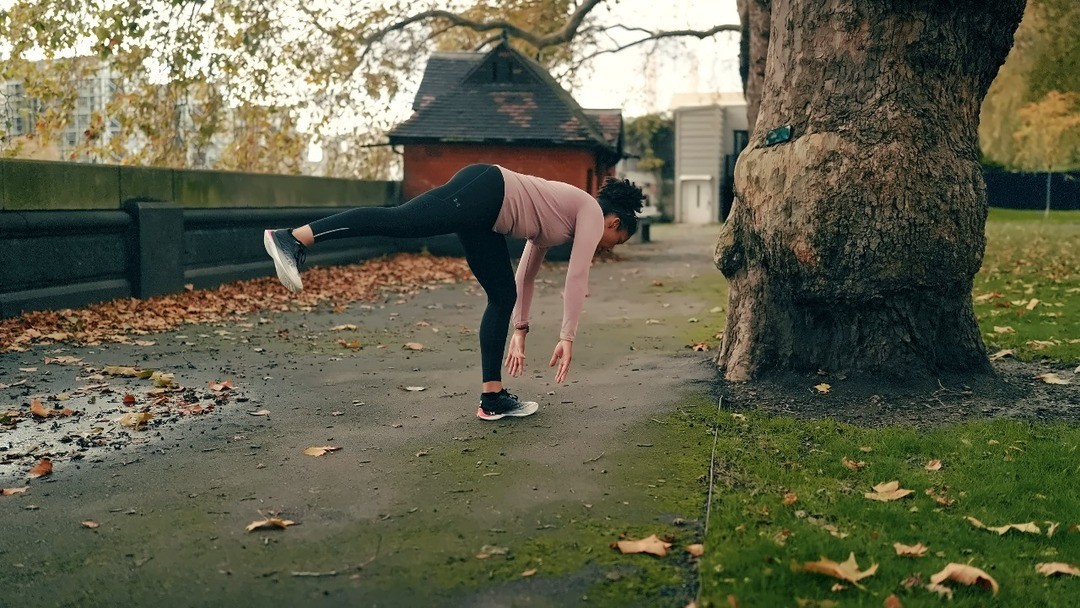
Stand with your feet hip-width apart. Bend forward at your hips and lift the toe of one foot up, keeping that leg straight with a relaxed knee while bending the other knee slightly. You should feel the stretch along the back of your straight leg from your sit bone to your knee. Hold for 30 seconds and switch sides.
Running Lunge
This stretch opens your hip flexors and improves hip extension, which directly affects stride length and force transfer through your posterior chain.
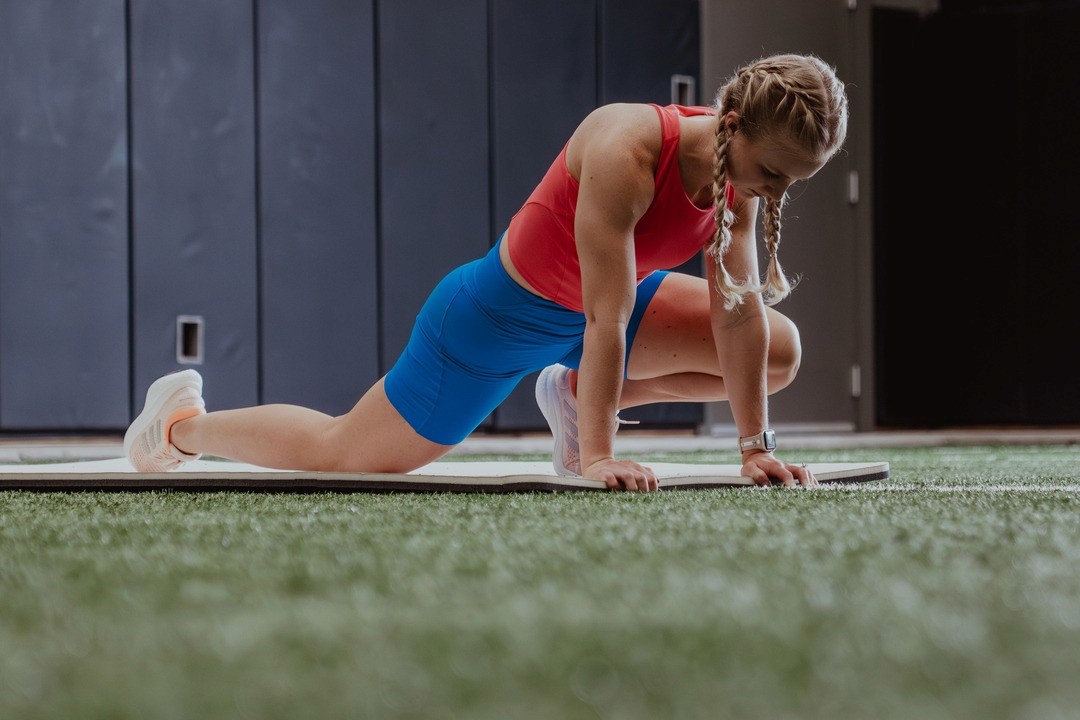
From a plank or downward-facing dog position, step your right foot to the outside of your right hand. Push your hips forward while engaging your back glute to release hip flexor tension. Hold for 30 seconds, then switch sides.
Figure-Four Stretch
This targets the piriformis, the small muscle beneath your glute max that aids hip rotation. When it tightens, it restricts external rotation and contributes to inward knee collapse, which overloads the joint.
How do you perform the figure-four stretch properly?
Lie on your back. Cross your left ankle over your right knee. Grab the back of your right thigh and pull it toward your chest. You should feel a deep stretch in your left glute. Hold for 30 seconds. Switch sides.
How can you enhance recovery with foam rolling?
Use a lacrosse ball or tennis ball to roll out your posterior glute muscles, IT bands, quads, and hamstrings. Spend 60 to 90 seconds on each area, pausing on tender spots to allow tissue release. This restores tissue quality so muscles can lengthen and contract through their full range during your next run.
What symptoms require immediate medical attention?
If you notice swelling at the knee joint, get it checked out. Swelling indicates inflammation beyond the normal post-exercise response and can signal structural damage that won't resolve with rest and mobility work alone. A sports medicine physician can identify the exact problem, rule out ligament or meniscus damage, and provide gait analysis to identify mechanical flaws in your running form.
When should you seek help for persistent stiffness?
If your stiffness doesn't improve within a few weeks despite doing the strength exercises and stretching routines explained here, seek professional intervention. Persistent symptoms suggest a deeper biomechanical issue or underlying condition requiring targeted treatment. For runners with upcoming races, professional support can accelerate recovery and build confidence to safely push your pace.
Measuring stiffness and knowing when to seek help matters only if you can fix the movement patterns causing the problem.
Related Reading
Left Arm Stiffness
Stretches For Lower Back Stiffness
Hip Stiffness Exercises
How To Relieve Morning Back Stiffness
Hand Stiffness Exercises
Finger Stiffness And Locking Treatment
How To Get Rid Of Neck Stiffness
Best Supplements For Muscle Pain And Stiffness
Muscle Stiffness Treatment
How To Reduce Stiffness After an Ankle Sprain
Knee Stiffness After Running? Improve Your Mobility in Minutes
Knee stiffness after running signals that muscles around your knee—especially your quads, hips, and glutes—aren't absorbing enough load during runs. When those muscles tighten or tire, the knee joint absorbs more stress, causing stiffness the following day.
🎯 Key Point: Most runners stretch randomly after a run, targeting whatever feels tight without addressing the underlying restrictions that caused the stiffness. As training gets more complex (more miles, faster paces, varied terrain), that reactive approach breaks down. You end up chasing symptoms instead of fixing the movement limitations that let your knee absorb too much impact.
"When muscles around the knee aren't absorbing enough load during runs, the knee joint takes more stress, causing stiffness the next day." — Movement Analysis Research
Apps like Pliability provide structured mobility routines tailored to your body and training needs. Our guided video sessions target tight hip flexors, weak glutes, and restricted ankle mobility: the exact areas that determine whether your knee distributes load efficiently. You get personalized daily programming designed to improve the range of motion and reduce stiffness in minutes, without equipment.
⚠️ Warning: After your next workout, rate your knee stiffness from 1 to 10. Complete a short mobility session and check your stiffness again the next day. Many runners notice improved movement and reduced stiffness within a few sessions. Try it with a 7-day free trial on iPhone, iPad, Android, or web.
Problem Area | Target Solution | Time Required |
|---|---|---|
Tight Hip Flexors | Guided stretching sequences | 3-5 minutes |
Weak Glutes | Activation exercises | 2-4 minutes |
Restricted Ankles | Mobility drills | 2-3 minutes |






Move better in 10 minutes a day.
10,000+ five-star reviews.