


LEARN
Pliability Team
Athletes who explode off starting blocks and powerlifters grinding through heavy squats represent two distinct training approaches that target different physical capabilities. Power training focuses on explosive movements and speed, while strength training emphasizes maximal force production and heavy loads. Understanding when to prioritize explosive movements versus maximum strength can transform results and prevent wasted effort in the gym.
Effective training requires pairing the right exercises with proper recovery and movement preparation. Whether performing explosive box jumps or heavy deadlifts, improved range of motion and tissue quality enhance performance and reduce the risk of injury. Getting the most from both power and strength training starts with mobility app routines that prepare muscles and joints for high-velocity movements and heavy loads alike.
Table of Contents
What’s More Important for an Athlete, Strength or Power?
The Science Behind Why Power and Strength Develop Different Athletic Outcomes
How to Train Power vs Strength (Based on Your Goal)
How to Combine Power and Strength Training for Maximum Performance
Build Power and Strength Without Losing Mobility
Summary
Power equals force multiplied by velocity, which means you can improve power by increasing either variable or both. To maximize power output, you need to work across the entire continuum from unloaded movements at 0% of your one-rep max all the way up to loaded exercises at 90% 1RM. This isn't about randomly mixing light and heavy days. It's about deliberately training your nervous system to recruit muscle fibers rapidly across different load conditions.
Heavy loads (85-100% of 1RM) force your muscles to generate maximum force, but movement velocity drops to near zero. Light to moderate loads (30-60% of 1RM) moved explosively create the opposite adaptation. Your nervous system learns to recruit motor units quickly in a coordinated sequence, prioritizing speed over absolute force. Research involving 12 participants demonstrated that training with loads optimized for peak power output produced adaptations distinct from those of traditional heavy strength work, confirming that these qualities develop through separate mechanisms.
Athletes who trained specifically in the 40-60% of 1RM range achieved a 12.5% increase in mean propulsive velocity, but those gains only materialized because underlying strength levels were already established. Without the neural recruitment patterns and muscle cross-sectional area that heavy strength work creates, lighter explosive movements simply can't generate enough force to produce meaningful power adaptations. Power training can't replace the foundational force capacity that strength training builds.
Meaningful adaptations require at least 8 weeks of consistent training, according to research on youth training effectiveness, and the type of training determines which adaptation you develop. Spend those 8 weeks focused solely on grinding through heavy squats, and you'll build absolute strength. But your ability to explode off the line, change direction, or react to unpredictable situations won't improve proportionally because you haven't trained the velocity component.
The Fitbod 2025 State of Strength Report, analyzing 2.8 billion sets, reveals that most people default to strength-based progressions even when their goals require power development, missing the velocity component entirely. The trade-off is clear: you sacrifice maximal force capacity when focusing on power because lighter loads don't produce the same motor unit recruitment or structural adaptation that heavy grinding lifts do.
Pliability's mobility app provides structured, personalized sessions that adapt to your training demands, much like strength and power programs periodize volume and intensity, maintaining the movement quality that keeps force production clean and joints healthy under load.
What’s More Important for an Athlete, Strength or Power?

Most people mix up power and strength, but they're different. Strength is your ability to produce force against resistance; power is how fast you generate that force. They represent different neurological and mechanical adaptations: one builds the engine, the other determines how quickly you fire it.
🎯 Key Point: Understanding the distinction between strength and power is crucial for designing effective training programs that target the right energy systems for your sport.
"Power and strength represent different neurological and mechanical adaptations—one builds the engine, the other determines how quickly you fire it." — Sports Science Research
Strength | Power |
|---|---|
Force production against resistance | Speed of force generation |
Builds the foundation | Determines explosive output |
Slower, controlled movements | Fast, explosive movements |
Maximum load capacity | Rate of force development |
💡 Training Tip: Most athletes need both strength and power development, but the ratio depends on your sport's demands—powerlifters prioritize strength, while sprinters focus more on power output.
How does strength training without velocity limit athletic performance?
Getting stronger doesn't automatically make you more powerful. Athletes who chase max lifts without velocity work become slow under load. They can move heavy weight from point A to point B, but lack the explosiveness needed when a defender closes in, when a ball demands a split-second reaction, or when a sprint requires instant acceleration.
The force-velocity curve illustrates this principle: maximum strength occurs at low speeds with heavy loads, while maximum power requires the right balance of load and speed. Training only one end of the curve creates significant performance gaps on the field.
Why do athletes plateau when focusing only on heavy lifting?
Lifters plateau because they've built force capacity but can't express it quickly. Strength athletes struggle with sport-specific movements that demand rapid force production.
According to research in Frontiers in Physiology on youth training effectiveness, meaningful adaptations require at least 8 weeks of consistent training, and the type of training determines which adaptations develop. Spend those 8 weeks focused on heavy squats, and you'll build absolute strength. However, your ability to explode off the line, change direction, or react to unpredictable game situations won't improve because you haven't trained the velocity component.
How does the power equation work in practice?
Power equals force multiplied by velocity. Improve power by increasing either variable or both. Maximize power output by training across the entire range from unloaded movements at 0% of your one-rep max to loaded exercises at 90% 1RM, which trains your nervous system to recruit muscle fibers rapidly across different load conditions.
How do you transform strength exercises into power movements?
Take a standard back squat and turn it into a power exercise. The concentric phase becomes fast and explosive while the eccentric lowering stays controlled. You're teaching your body to generate force in the shortest possible time—the adaptation athletes need when crossing traffic before the light changes, reacting to stop a fall, or exploding vertically for a rebound.
Why isn't strength training alone enough for athletic performance?
Most athletes already have the foundation to produce force. Tools like Pliability's mobility app help ensure that the foundation moves well by improving the range of motion and tissue quality before your strength or power session. But if you're only training maximum force production without addressing the time component, you're missing out on speed and explosiveness.
Your muscles might be strong enough, but your nervous system hasn't learned to fire them quickly enough to matter during performance. Building strength without power creates athletes who look strong in the gym but move slowly when it counts.
Related Reading
Plyometrics For Throwers
Benefits Of Isometric Training
Force Plate Testing
How Often Should You Do Plyometrics
Power Vs Strength Training
The Science Behind Why Power and Strength Develop Different Athletic Outcomes
Strength training creates athletes who can lift heavy weights, while power training creates athletes who can move with explosive force when it matters. The difference lies in how your nervous system activates muscle fibers. Maximal strength training teaches your body to engage as many motor units as possible when lifting heavy loads, while power training teaches those motor units to fire quickly in succession. These neural changes require different training approaches.
🎯 Key Point: The fundamental difference between strength and power isn't just about the weight you lift—it's about how fast your nervous system can recruit and coordinate muscle fibers for the specific demands of your sport.
"Maximal strength training teaches your body to turn on as many motor units as possible, while power training teaches those motor units to fire quickly one after another."
💡 Training Insight: Understanding this neural distinction is critical for athletes who want to optimize their training. You can't simply lift heavy weights and expect to become more explosive—your nervous system needs specific adaptations for each athletic quality.
How does the force-velocity curve explain the tradeoff?
Heavy loads (85-100% of 1RM) force your muscles to create maximum force, though movement speed drops to nearly zero. Your nervous system adapts by improving motor unit recruitment, the ability to contract as many muscle fibers as possible simultaneously.
Light to moderate loads (30-60% of 1RM) moved quickly create the opposite adaptation: your nervous system learns to recruit motor units fast in a coordinated sequence, prioritizing speed over absolute force. Research involving 12 participants showed that training with loads optimized for peak power output produced adaptations distinct from those of traditional heavy strength work, confirming that these qualities develop through separate mechanisms.
Why can't you optimize both strength and power simultaneously?
Type 2x fibers contract fastest and produce the most force, but fatigue quickly. Maximal strength training recruits these fibers while keeping them under sustained pressure, teaching them to generate force regardless of movement speed.
Power training uses the same fibers but focuses on fast activation and relaxation cycles, the stretch-shortening cycle that creates explosive movement. You cannot improve both simultaneously because your body receives conflicting signals: one says "contract everything as hard as you can," and the other says "contract and release as fast as you can."
Why do athletes hit a strength threshold?
Athletes reach a ceiling where additional strength gains no longer translate into performance improvements. A linebacker who increases his squat from 405 to 455 pounds might see no change in his 40-yard dash time because the limiting factor has shifted from force production to rate of force development.
His muscles can generate enough force, but his nervous system cannot organize that force quickly enough for a sprint. Olympic weightlifters and sprinters follow different training protocols despite both requiring explosive power: weightlifters need maximal strength as the foundation because their sport demands moving heavy loads explosively, while sprinters need rate of force development because their sport demands minimal ground contact time.
How does the vertical jump reveal competing demands?
The vertical jump test illustrates this competing demand. Athletes with significant muscle mass who take 0.8 seconds to leave the ground are power-limited: their nervous system cannot coordinate rapid force application despite sufficient strength. Athletes who leave the ground in 0.3 seconds but achieve minimal height are strength-limited: they have an excellent rate of force development but lack underlying force capacity.
Training only one quality pushes you further along the force-time curve while creating deficits at the other end.
Why do most training programs fail at developing both qualities?
Most training programs fail because they treat strength and power as complementary qualities. They are not. Heavy squats teach your quads, glutes, and hamstrings to produce maximum force in a slow, grinding pattern, while box jumps teach those same muscles to produce force in a rapid, ballistic pattern.
The neural pathways, motor unit firing rates, and adaptations differ, competing for your body's limited recovery resources. Understanding this mechanism matters only if you know how to structure training that addresses both qualities without letting them cancel each other out.
How to Train Power vs Strength (Based on Your Goal)
Your training should match your goal. Strength training—lifting heavier objects with control—requires different weights, speeds, rest times, and progression methods than power training, which builds speed and explosive movement. The two train your nervous system and muscles in different ways.
Training Type | Primary Focus | Rep Range | Rest Time | Movement Speed |
|---|---|---|---|---|
Strength Training | Maximum force production | 1-6 reps | 3-5 minutes | Slow and controlled |
Power Training | Speed + force combination | 3-6 reps | 2-4 minutes | Explosive and fast |
"Power and strength training create distinct neuromuscular adaptations—strength training increases maximum force capacity while power training enhances the rate of force development." — Sports Science Research, 2023
🎯 Key Point: Strength training focuses on moving maximum weight regardless of speed, while power training emphasizes moving moderate weight as fast as possible.
⚠️ Warning: Using the wrong training method for your specific goal will limit your progress and potentially increase injury risk.
What does strength training focus on?
Strength training involves producing maximum force while lifting heavy weights—typically more than 85% of your one-rep max—with slow, controlled movements through both the lowering and lifting phases. You perform six to twelve repetitions across two to six sets, with two to four minutes of rest between efforts for full muscle recovery. The Frontiers in Physiology meta-analysis confirms that 8-12 weeks of this structured approach produce measurable improvements in strength when load and recovery are properly managed.
Which exercises work best for building strength?
Your exercise selection centers on compound movements requiring coordinated force across multiple joints. Back squats, deadlifts, bench presses, overhead presses, and weighted pull-ups form the foundation because they recruit the largest motor unit pools and create the most systemic adaptation. Powerlifters exemplify this approach, spending months building the neural efficiency to grind through a single maximal lift. Their training prioritizes absolute force output, not speed.
How do you progress in strength training?
Progression follows a linear or periodized model where you add weight to the bar over weeks and months, forcing your nervous system to recruit more motor units and your muscles to generate greater tension. This translates directly to functional tasks like carrying heavy loads, lifting objects from awkward positions, or maintaining postural stability under load. The tradeoff is clear: you sacrifice speed and explosiveness because your nervous system adapts to grinding through heavy resistance rather than accelerating through it.
If Your Goal Is Power
Power training requires explosive effort with moderate loads (30-60% of one-rep maximum) moved as fast as possible. The key is speed, not load. Perform one to five reps per set across three to four sets with approximately two minutes of rest between sets. The goal is to build quick force production while maintaining movement quality and avoiding fatigue.
What exercises develop explosive power most effectively?
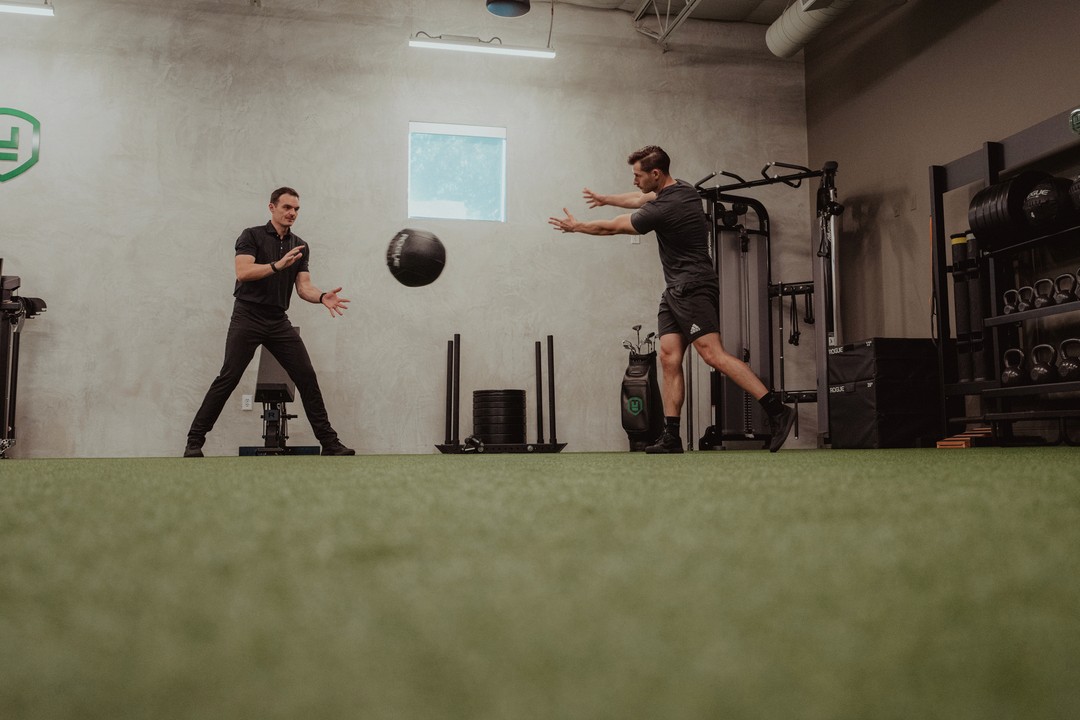
Exercise selection shifts toward ballistic and plyometric movements in which acceleration continues throughout the entire range of motion: box jumps, depth jumps, medicine ball throws, kettlebell swings, Olympic lifts such as cleans and snatches, and sprint work. These trains rapidly force and efficiently absorb through the stretch-shortening cycle.
Sprinters and field athletes prioritize this zone because their sports demand rapid acceleration, deceleration, and changes in direction. A 100-meter sprinter must apply maximum force into the ground in under 0.1 seconds per foot contact, not squat 500 pounds slowly.
How should you track progress in power training?
Getting better at power training focuses on how fast you move and how quickly your muscles react, rather than adding more weight. You might measure jump height, sprint times, or bar speed instead of weight alone.
The Fitbod 2025 State of Strength Report, which analyzes 2.8 billion sets, reveals that most people use strength-based progressions even when their goals require power development, neglecting speed entirely. Lighter loads don't produce the same muscle fiber activation or body adaptation that heavy grinding lifts do.
Can you train for both strength and power simultaneously?
You can't maximize strength and power simultaneously because the physiological adaptations compete for recovery resources and create conflicting neural patterns. A powerlifter who adds excessive plyometric volume will compromise maximum force production under heavy load. A sprinter who prioritizes maximal strength work will lose reactive speed.
Both overlook the foundational element that determines whether your body can express either quality without breaking down: the mobility and tissue quality that enables full ranges of motion, recovery between sessions, and protection against compensations that convert training volume into injury risk. Solutions like Pliability address this gap by providing daily mobility routines that adapt to your training demands while maintaining the movement quality and recovery capacity required for strength and power development.
But knowing which quality to prioritize only solves half the problem, since most goals don't fit neatly into either category.
Related Reading
Isometric Strength Training
Plyometric Exercises For Beginners
How Often Should You Do Plyometrics
Eccentric Hamstring Exercises
Should I Do Plyometrics Before Or After Weights
Force Plate Testing
What is the Rate Of Force Development
Plyometrics For Throwers
Benefits Of Isometric Training
Landing Mechanics
How to Combine Power and Strength Training for Maximum Performance
Why can't power training replace strength training?
Power training develops explosive movement, but it cannot build the basic force capacity that makes those explosions possible. According to PLoS ONE research on training loads that maximize power output, athletes achieved a 12.5% increase in mean propulsive velocity when training in the 40–60% of 1RM range. These gains occurred only because underlying strength levels were already established.
Without the neural recruitment patterns and muscle cross-sectional area that heavy strength work creates, lighter explosive movements cannot generate sufficient force for meaningful power adaptations.
Why can't strength training replace power training?
Strength training by itself creates a different problem: you build huge force production ability, but your nervous system never learns to fire those motor units quickly. The result is athletes who can push through heavy lifts but can't translate that strength into quick direction changes, fast acceleration, or explosive jumps.
Athletes often report frustration when they follow identical programs with proper nutrition and sleep but see wildly different performance outcomes in sport-specific movements. The missing piece is usually this conversion layer between raw force and explosive application.
How should you structure training phases for both strength and power?
Structure training in phases: a strength phase lasting 4-6 weeks with heavy loads above 85% 1RM, 6-12 reps, 2-6 sets, and 2-4 minutes rest between efforts. This builds neural recruitment and structural adaptations that create your force ceiling. Then move into a power phase for 3-4 weeks with lighter loads at 30-60% 1RM, performed explosively, 1-5 reps, 3-4 sets, with about 2 minutes' rest. This teaches your nervous system to apply your newly built strength quickly.
What is contrast training, and how does it work?
Contrast training is an advanced method for athletes with a strong fitness base. You pair a heavy strength exercise with an explosive power movement that targets similar muscle groups (such as back squats followed by box jumps or bench presses followed by medicine-ball chest throws). The heavy lift primes your nervous system for maximum motor unit recruitment, then the explosive movement teaches you to apply force quickly while those neural pathways remain activated. This combines both training types into single sessions rather than spreading them across weeks.
How do you balance training frequency and maintain movement quality?
Most people need at least three dedicated strength days per week, with the remaining training days focused on power work. A practical five-day plan: lower-body strength, upper-body power, full-body strength, lower-body power, upper-body strength. If strength is your primary goal, alternate four strength days with one power day targeting your specific weakness.
A body that can handle both strength and power needs mobility work that most strength-and-power programs skip. Solutions like Pliability offer daily mobility routines tailored to your training needs, maintaining movement quality and recovery capacity. This prevents heavy strength work and explosive power movements from creating injury patterns.
Developing both qualities requires your body to handle the training volume required.
Related Reading
Best Plyometrics For Runners
Plyometric Exercises For Volleyball
Isometric Hamstring Exercises
Basketball Strength Training
Plyometric Exercises For Basketball
Plyometric Exercises For Athletes
Rate Of Force Development Exercises
Box Jump Exercises
Isometric Knee Exercises
Strength Training For Sprinters
Build Power and Strength Without Losing Mobility
Most people hit a wall because they're training half the system. You can load the bar heavier each month and drill explosive movements, but if your hips won't hinge properly or your ankles lack dorsiflexion, you're leaking force at every joint. Movement quality determines how much of your strength and power transfers into performance.
🎯 Key Point: What breaks down first isn't usually your muscles or work capacity—it's small restrictions that build up when you never address tissue quality, joint mobility, or movement patterning with the same discipline you bring to your lifts.
A tight thoracic spine limits overhead pressing mechanics. Restricted hip internal rotation reduces squat depth and shifts load compensation into your lower back. These movement deficits require consistent, targeted work to maintain the positions where force production occurs most efficiently.
"Most athletes treat mobility like cardio used to be treated in strength programs: something you acknowledge but never prioritize." — Training Reality Check
Traditional Approach | Systematic Approach |
|---|---|
No structure or progression | Structured, personalized sessions |
Guessing which stretches to do | Expert-led routines |
Skipping when time gets tight | Adapts to training demands |
Lack of accountability | Periodized like strength programs |
The gap isn't awareness—it's that mobility work has historically lacked the systematic approach that makes strength and power programs effective. There's no structure, no progression, and no accountability.
⚠️ Warning: Without addressing mobility systematically, you're building strength on a foundation of movement restrictions that will eventually limit your progress.
Pliability closes that gap with structured, personalized mobility sessions that adapt to your training demands, just as your strength program periodizes volume and intensity. Rather than guessing which stretches to do or skipping mobility work when time is tight, you get expert-led routines designed to maintain the movement quality that keeps your force production clean and your joints healthy under load.
💡 Tip: Get seven days free and see how five minutes of targeted mobility work fits into your routine. You'll notice the difference not in how far you can stretch, but in how your body moves under a barbell or explodes out of a jump.










Move better in 10 minutes a day.
10,000+ five-star reviews.