


LEARN
Pliability Team

That nagging tightness between the shoulder blades makes turning your head feel like a chore, while the dull ache that settles in after hours at a desk limits everything from reaching into the backseat of a car to simply looking over your shoulder while driving. Upper back stiffness affects millions of people, creating constant reminders of restriction throughout daily activities. Understanding the root causes of this discomfort provides the foundation for developing effective strategies to relieve tension and restore comfortable movement.
Targeted guidance designed specifically to address muscle tension, poor posture patterns, and limited range of motion offers a more effective approach than guessing which stretches might help or scrolling through endless videos. Clear direction on releasing tight muscles and restoring natural movement leads to real relief from upper back stiffness. Rather than letting pain hold you back from daily activities, consider using a mobility app to reclaim comfortable movement and get back to living without constant discomfort.
Table of Contents
Why Is My Upper Back Stiff and Tight?
How Upper Back Stiffness Develops and What You Can Do About It
Actionable Steps to Reduce Upper Back Stiffness Today
Relieve Upper Back Stiffness and Improve Mobility Today
Summary
Upper back stiffness develops when muscles hold tension longer than they're designed to, causing metabolic waste to accumulate faster than blood flow can clear it. For every inch your head shifts forward from neutral alignment, your neck muscles support an additional ten pounds of effective weight. Sitting with your head three inches forward means your neck bears 40 pounds instead of 12, pulling your upper back into a rounded position that lengthens and weakens the muscles between your shoulder blades while shortening the chest muscles.
Over half of adults experience upper back pain at least once a year, yet most dismiss it as a minor inconvenience rather than addressing the underlying muscle imbalances. What feels like occasional tightness can progress to chronic pain and reduced mobility within months if left unaddressed. Muscles that stay tight for weeks begin to shorten structurally, while joints that don't move through their full range lose the ability to do so, locking you into a dysfunction cycle that becomes harder to break over time.
Thoracic spine stiffness can reduce rotational range by more than thirty degrees compared to upright posture. When you sit slumped and try to twist your torso, the restricted movement doesn't disappear. It transfers to your lumbar spine, hips, and shoulders, forcing those joints to move beyond their optimal range to compensate for what your thoracic spine can't provide, which increases injury risk across multiple areas.
Standard relief methods such as massage, heat, and stretching temporarily address symptoms but do not address the root cause. If your shoulder blade lacks the strength to maintain proper position, muscles will tighten again to compensate, regardless of how much you foam roll. The missing piece isn't intensity or effort; it's targeting the specific movement deficits and muscle imbalances driving the restriction, such as weak lower traps that can't depress your shoulder blade or stiff thoracic vertebrae that won't rotate.
Range of motion loss happens incrementally rather than dramatically. You don't wake up unable to reach overhead. Instead, you start compensating without noticing, leaning sideways instead of extending your spine or hiking your shoulder up instead of rotating your arm smoothly. Each compensation reinforces the restriction as your nervous system learns the altered pattern and treats it as normal, making movements that once felt effortless require conscious effort or become impossible without pain within months.
Pliability's mobility app addresses this by providing daily routines designed to loosen tight muscles, improve thoracic spine mobility, and restore range of motion through guided video instruction, along with a body-scanning feature that helps identify which areas need the most attention.
Why Is My Upper Back Stiff and Tight?

Your upper back gets tight when muscles work harder due to misalignment, prolonged static positioning, or unnatural movement patterns. The stiffness you feel is muscle exhaustion: muscles never fully relax because your posture, habits, or stress keep them locked in a protective state.
🎯 Key Point: Muscle tension in your upper back isn't just about temporary discomfort—it's your body's warning system telling you that something in your daily routine needs to change.
"Chronic muscle tension develops when muscles remain in a contracted state for extended periods, leading to reduced blood flow and increased stiffness." — American Physical Therapy Association
⚠️ Warning: Ignoring persistent upper back tightness can lead to compensatory movement patterns that create additional problems in your neck, shoulders, and lower back over time.
Why does sitting position matter more than sitting itself?
Sitting at a desk doesn't hurt you. Sitting in the same forward-leaning position for six hours without shifting does. Your trapezius and rhomboids are designed to move your shoulder blades through space, stabilize your arms during reaching and lifting, and return to neutral, not maintain static tension.
When you hunch over a laptop or crane your neck toward a screen, those muscles stay partially contracted to keep your head and shoulders from collapsing forward. This tension accumulates, reducing blood flow and allowing metabolic waste to accumulate. What starts as mild morning tightness becomes a dull afternoon ache and sharp evening discomfort.
How does tension build up throughout the day?
The pattern repeats during commutes, phone scrolling, and even sleep if your pillow forces your neck into an awkward angle. Each activity adds another layer of strain to muscles that never fully release from the previous one.
One person discovered muscles in their upper back were "incredibly stiff" only after an injury forced them into treatment, realizing tension had been building for over a decade unnoticed. Tightness creeps in so gradually that it feels normal until something breaks.
How does your nervous system respond to stress?
Your body doesn't distinguish between physical and emotional threats. When stress hits, your nervous system triggers the same protective response as a physical threat: muscles tense, breathing becomes shallow, and shoulders rise toward your ears. The trapezius and levator scapulae muscles bear the brunt of this reaction.
While acute stress releases quickly, chronic stress keeps muscles partially contracted for hours or days. This sustained tension restricts circulation, limits oxygen delivery, and leaves muscles metabolically fatigued without physical exertion.
How do posture and stress create a feedback loop?
Poor posture and emotional tension create a feedback loop. Weak, overstretched muscles between your shoulder blades cannot balance tight chest muscles. Your upper traps and neck compensate by working harder, while stress causes further clenching.
The longer this cycle continues, the harder it becomes for your body to find a neutral resting position, and you carry tension even when relaxing.
How do everyday activities create muscle tension?
Reaching overhead to put away dishes. Lifting a toddler out of a car seat. Pulling a suitcase from an overhead bin. These movements aren't inherently harmful, but repetition without proper muscle activation can cause microtrauma.
If your lower traps aren't firing correctly to stabilize your shoulder blade, your upper traps and neck compensate. Repeat this pattern fifty times weekly for six months, and the overworked muscles develop chronic tightness while the underactive stabilizers weaken.
Why do athletes develop persistent muscle knots?
Athletes and gym-goers face a different version of the same problem. Lifting heavy without proper warm-up or pushing through fatigue with compromised form causes muscles, tendons, and ligaments to contract defensively. That protective tightness often persists after the workout ends.
Previous injuries leave scar tissue and altered movement patterns, making certain areas more susceptible to re-injury. A twinge from six months ago can become a persistent knot because your body learned to guard that spot and never fully released it.
What mechanical issues cause most upper back stiffness?
Most upper back stiffness stems from mechanical issues you can address through movement, posture correction, and stress management. However, tightness can signal deeper structural problems, such as disc degeneration, herniated discs, and spinal stenosis, which can compress nerves or trigger inflammation that radiates through surrounding muscles. Arthritis, whether degenerative osteoarthritis or inflammatory conditions such as rheumatoid arthritis and ankylosing spondylitis, affects the spinal joints and ribs, causing stiffness that worsens with inactivity.
How can you tell when stiffness indicates nerve compression?
Nerve compression causes clear symptoms: radiating pain, numbness, tingling, or weakness that travels from your upper back into your arms or hands. Spinal curvature disorders like scoliosis or kyphosis force uneven muscle compensation, with one side working harder to counterbalance the curve. In rare cases, pain you interpret as upper back stiffness originates elsewhere: gallbladder issues, heart conditions, and lung problems can all refer pain to the upper back. If stiffness doesn't respond to typical interventions or accompanies shortness of breath, chest pressure, or digestive changes, the cause may not be muscular.
Why do most people ignore early warning signs of upper back pain?
More than half of adults experience upper back pain at least once a year, treating it as a minor inconvenience rather than a warning sign. This dismissal allows muscle imbalances to deepen, range of motion to shrink, and compensatory patterns to become permanent.
Occasional tightness can progress to chronic pain, reduced mobility, and increased injury risk within months if left unaddressed. The body adapts to dysfunction: muscles that stay tight for weeks shorten structurally, joints lose their full range of motion, and weak stabilizers weaken while overactive muscles tighten. This cycle becomes harder to break the longer it runs.
What makes traditional approaches to upper back stiffness ineffective?
Traditional approaches to upper back stiffness focus on symptom relief, such as massage, heat, and stretching. These provide temporary relief but don't address the underlying cause. Without retraining movement patterns, strengthening underactive stabilizers, and restoring balanced mobility, stiffness returns once you sit at your desk or pick up your child again.
Solutions like Pliability shift focus from isolated relief to systematic retraining. Guided routines target the specific muscle imbalances and movement restrictions contributing to upper back tightness, helping you restore natural alignment and build resilience against the positions and stresses that caused the problem.
Understanding what causes tightness matters only if you recognize how those causes compound over time and what breaks the cycle.
Related Reading
How Upper Back Stiffness Develops and What You Can Do About It

Upper back stiffness develops through a mechanical cycle: muscles contract to stabilize your spine and shoulder blades, but when they hold tension longer than designed, metabolic waste accumulates faster than blood flow clears it. Oxygen delivery drops, tissue becomes hypoxic, and pain receptors trigger further muscle guarding. Ligaments connecting vertebrae and ribs lose elastic recoil when held in shortened positions, and your spine's natural alignment shifts forward, forcing posterior muscles to work against gravity instead of with it.
🎯 Key Point: The root cause of upper back stiffness isn't just poor posture - it's the metabolic disruption that occurs when muscles can't get adequate oxygen and nutrient delivery while under constant tension.
"When muscles hold tension longer than designed, metabolic waste accumulates faster than blood flow can clear it, creating a cascade of tissue hypoxia and pain receptor activation."
⚠️ Warning: Many people try to "push through" upper back stiffness with more activity, but this can worsen the metabolic disruption and prolong the muscle guarding cycle. The key is strategic intervention that restores blood flow and tissue oxygenation.
What causes tissue restriction between the shoulder blade and spine?
The area between your shoulder blades and mid-spine contains rhomboids, middle trapezius, and deeper rotator muscles that control shoulder blade positioning. When these muscles develop adhesions or trigger points due to prolonged tension, they cannot fully lengthen. Raising your arm overhead requires your shoulder blade to rotate upward and slide along your rib cage. If the muscles anchoring that blade are stiff, the movement stops short, or your neck and upper trapezius have to compensate.
How can you test and release shoulder blade restrictions?
One simple test shows how much tightness you're carrying. Lie on your back with a lacrosse ball positioned between your shoulder blades and spine. Press gently into areas that feel thick or stuck, not sore. Slowly raise your arm toward the ceiling and notice where the movement feels blocked or uncomfortable.
Move your arm back and forth at that end range while keeping pressure on the tight tissue. The ball creates a focal point that lets muscle fibres slide against each other, breaking up adhesions that limit movement. Retest your arm lift. Most people gain five to fifteen degrees of range within sixty seconds.
How does forward head posture increase spinal stress?
Your head weighs about ten to twelve pounds in a neutral position. For every inch your head moves forward, the stress on your cervical spine increases by about ten pounds. If you sit with your head three inches forward, your neck muscles must support forty pounds instead of twelve.
This forward head posture pulls your upper back into a rounded position, lengthening and weakening the muscles between your shoulder blades while shortening the chest and front shoulder muscles. According to the Cleveland Clinic, upper back pain affects many people, with postural dysfunction being a common cause.
Why do ligaments lose their supportive function over time?
The ligaments connecting your thoracic vertebrae adapt to your most frequent position. Spend eight hours daily hunched forward, and those ligaments gradually lose tension in their stretched state, eliminating the passive support your spine needs to maintain upright posture without muscular effort.
Your muscles compensate by staying partially contracted even during rest, preventing full recovery. Blood flow remains restricted, inflammation persists, and the stiffness you feel in the morning exists because your muscles never fully release overnight.
How does thoracic spine stiffness limit your movement range?
Your thoracic spine mobility affects how well your shoulder blade can move. Each rib connects to a vertebra through small joints that allow rotation and side-bending. When those joints stiffen, your upper back loses its ability to rotate.
Try this: sit slumped and twist your torso right, noting how far you turn. Now sit upright with your chest lifted and repeat. The difference in range can exceed thirty degrees. That lost rotation transfers to your lumbar spine, hips, and shoulders, forcing those joints to move beyond their optimal range to compensate.
What happens when movement restrictions become permanent?
Reaching overhead becomes difficult when your upper back cannot extend. Pulling movements feel weak when your shoulder blades cannot fully pull back. Breathing becomes shallow when your ribs cannot expand properly.
Your rotator cuff works harder to stabilize a shoulder blade that won't stay in position. Your neck muscles strain to rotate your head while sitting on a stiff upper back. Temporary stiffness becomes a permanent movement limitation, affecting athletic performance and sleep.
Why do standard relief methods only provide temporary results?
Massage, heat, and stretching provide temporary relief by increasing blood flow, calming nerve endings, and lengthening tissue, but none address why muscles tighten initially. If your shoulder blade lacks the strength to maintain proper position, muscles will tighten again to compensate. If your thoracic spine can't rotate, stretching your upper traps won't create lasting change because they'll immediately contract again to stabilize what your spine can't control.
What causes the cycle of stiffness to return?
The typical pattern is temporary relief followed by a return to baseline stiffness within hours or days. People seek tighter spots and press harder, assuming intensity will break the cycle. But intensity without precision creates more inflammation. The missing piece is targeting the specific movement deficits and muscle imbalances driving the restriction: weak lower traps that cannot depress your shoulder blade, stiff thoracic vertebrae that won't rotate, and overactive upper traps compensating for underactive mid-back stabilizers. Until those patterns change, stiffness persists regardless of the frequency of foam rolling.
How does addressing movement patterns differ from traditional approaches?
Traditional approaches treat upper back stiffness as a tissue problem requiring manual intervention. But stiffness is a movement problem requiring pattern correction. Platforms like Pliability shift focus from isolated relief to systematic retraining, using guided routines that target the specific muscle imbalances and mobility restrictions locking your upper back. Rather than chasing the same tight spots nightly, you rebuild the movement capacity and postural control that prevent restrictions from forming.
How does range of motion loss develop without you noticing?
Loss of range of motion happens slowly over time. You start making changes to how you move without realizing it: leaning to the side to reach a high shelf instead of straightening your spine, lifting your shoulder up instead of rotating your arm smoothly. Each change reinforces the restriction. Your nervous system learns the new pattern and treats it as normal. Within months, movements that once felt easy require conscious thought or become impossible without pain.
Why do athletes notice upper back stiffness first in performance?
Athletes notice this first in performance decline. A tennis serve loses power due to limited thoracic rotation. A swimmer's stroke becomes asymmetric when one shoulder blade does not glide properly. A runner develops neck pain because their upper back cannot absorb rotational forces from arm swing. Limited upper back mobility forces other joints beyond their optimal range, increasing injury risk and reducing efficiency in movement patterns involving the arms or spine.
What interventions actually reverse stiffness instead of masking it?
Understanding how stiffness develops matters only if you know which interventions actually reverse the process rather than just temporarily mask it.
Related Reading
Elbow Stiffness And Pain
Mid Back Stiffness
Lower Back Stiffness
Thumb Stiffness And Locking
Upper Back Stiffness
Actionable Steps to Reduce Upper Back Stiffness Today

Your movement quality improves when you fix specific problems rather than relying on generic stretching routines. The exercises below target the movement patterns causing upper back stiffness: limited thoracic rotation, weak scapular stabilizers, and tissue adhesions between your shoulder blade and spine. Some restore mobility to stiff joints, others strengthen underactive muscles, and a few break up tissue restrictions that limit glide. The sequence matters because mobility without stability creates compensation, and strength without range of motion reinforces dysfunction.
🎯 Key Point: Target the root cause of your stiffness rather than applying generic solutions. Thoracic rotation, scapular stability, and tissue quality are the three pillars that determine your upper back function.
"The sequence matters because mobility without stability creates compensation, and strength without range of motion reinforces dysfunction." — Movement Quality Principles
⚠️ Warning: Skipping the proper sequence of mobility first, then stability, can actually worsen your movement patterns and create new compensation issues.
Problem Area | Target Focus | Expected Outcome |
|---|---|---|
Limited Thoracic Rotation | Restore joint mobility | Improved spinal movement |
Weak Scapular Stabilizers | Strengthen underactive muscles | Better shoulder blade control |
Tissue Adhesions | Break up restrictions | Enhanced tissue glide |
[IMAGE: https://im.runware.ai/image/os/a07d11/ws/2/ii/2ec615db-bfbf-4f36-a4b5-dacd9ff63d13.webp] Alt: Three-step process flow showing the correct sequence of mobility, stability, and strength training
How do you perform the book opener movement?
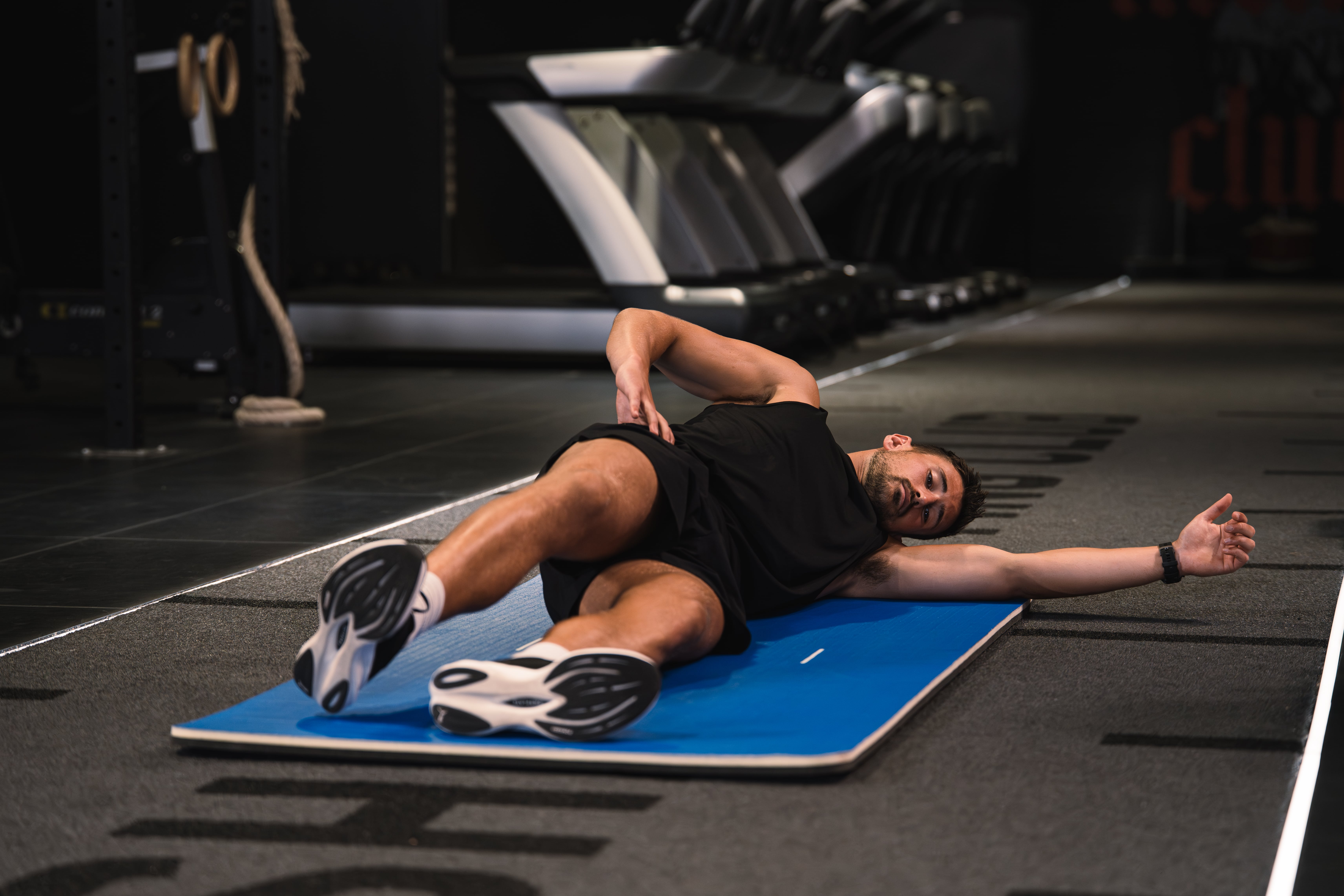
Lie on your side with knees bent and hands stacked directly in front of your chest. Lift your top arm toward the ceiling, then continue rotating through your chest to reach as far behind you as possible. Your head follows your arm throughout the movement. This thoracic rotation drill reveals where your mid-back loses rotational capacity. Most people stop rotating at the same point each time, typically around 45 degrees short of full spinal range. That stopping point is your restriction. With practice, your nervous system learns to access rotation without compensating through your lower back or shoulder.
Why does cervical spotting improve the exercise?
The cervical spotting component (following your hand with your eyes and head) integrates your neck into the rotation instead of keeping it locked forward. When your head and eyes move with your spine, your brain receives better feedback about your body's position in space. This feedback loop releases protective muscle guarding faster than stretching alone. Hold the end range for three breaths, then return slowly. Repeat five times per side. Notice whether one side rotates further than the other; that difference indicates which side needs more frequent attention.
How do you perform scapular retractions with arms at your side?
Sit upright with your arms relaxed at your sides. Pinch your shoulder blades together by pulling them straight back toward your spine. Hold for two seconds, then release. This exercise isolates your rhomboids and middle trapezius, the muscles responsible for pulling your shoulder blades into proper alignment.
Why do weak shoulder blade muscles cause neck tension?
When these muscles are weak or not working well, your upper traps take over, lifting your shoulders instead of pulling them back, creating the neck and upper shoulder tension common to desk work.
What's the proper form for scapular retractions?
Keep your shoulders down while you pull back. If your shoulders rise toward your ears during the squeeze, your upper traps are taking over the movement. Instead, pull your shoulder blades back and slightly down, as if sliding them into your back pockets. Do three sets of twelve repetitions.
How do you perform hip circles correctly?
Stand with your feet slightly wider than hip-width apart, hands on your hips, and make slow, controlled circles as if moving a hula hoop around your waist. Pay attention to where the motion feels restricted or choppy.
As you circle, gradually expand your range in the restricted directions without forcing it. Do ten circles in each direction. This drill works best as a warm-up before other mobility exercises because it activates your core stabilizers and prepares your nervous system for controlled movement through multiple planes.
Why do hip circles affect upper back function?
Hip mobility affects upper back function because your pelvis and rib cage work as a kinetic chain: limited hip rotation forces your lumbar and thoracic spines to compensate during twisting movements, transferring tension upward into your upper back and shoulders.
How do you perform the lower back rotation exercise?
Lie on your back with your knees bent and feet flat on the floor. Keep your shoulders pressed into the ground as you slowly lower both knees to one side. Your goal is spinal rotation, not touching the floor with your knees. Most people with upper back stiffness have limited thoracic rotation, causing their lower back to compensate by rotating excessively. This drill teaches your spine to distribute rotation evenly, rather than concentrating it in a few overworked segments.
What is the proper technique and repetition pattern?
Hold the rotated position for ten seconds, breathing deeply into your ribcage. As you exhale, allow your knees to drop slightly further if range permits. Return to the centre and repeat on the opposite side. Perform five repetitions per side. If one direction feels tighter, spend extra time there. Uneven rotation often occurs on the side where you carry your bag, favour one arm during lifting, or sleep in a particular position.
How do you perform pelvic bridging correctly?
Lie flat with your knees bent and feet planted firmly on the ground. Press through your heels and lift your hips toward the ceiling while pushing your shoulders down into the floor. This creates opposing forces that decompress your spine and activate your posterior chain. Hold the top position for five seconds, then lower slowly. Repeat ten times.
Why does pelvic bridging help with back pain?
Weak glutes force your spinal erectors to work harder during standing and walking. Strengthening your posterior chain reduces the load on your back muscles and improves your posture and movement. Focus on squeezing your glutes at the top of the bridge: intentional muscle activation builds the mind-muscle connection needed for better movement patterns outside the exercise.
How do you perform serratus anterior wall slides correctly?
Stand facing a wall with your forearms at chest height, palms facing each other, and little fingers touching the wall. Slide both arms upward in a V pattern, maintaining wall contact throughout. This targets your serratus anterior, which controls upward rotation and movement of your shoulder blade away from your spine. Weak serratus function causes shoulder blade winging during overhead movements, forcing your rotator cuff and upper traps to compensate.
What are the key form cues for wall slides?
As you slide your arms up, keep your rib cage down and your abs engaged. Most people arch their lower back to compensate for limited shoulder mobility, which undermines the exercise's purpose. If you can't slide overhead without arching, reduce your range and maintain neutral spine alignment. Perform three sets of ten repetitions. According to chiropractic professionals, targeted techniques like this address mobility and stability deficits that contribute to persistent upper back discomfort.
How do you perform the lower neck and upper back stretch?
Sit in a firm chair or stand tall. Clasp your hands together at shoulder height in front of you. Drop your chin toward your chest and reach straight forward, rounding your upper back. Pull your shoulder blades apart to create space between them. You'll feel a stretch across your upper back and shoulders, targeting the rhomboids and middle trapezius. Hold for 15 to 30 seconds while breathing deeply. Repeat two to four times.
Why does timing matter for this stretch?
This stretch works best after strengthening exercises because it lengthens muscles that have been activated. Stretching muscles after they've been engaged through their full range reinforces new movement patterns and helps your nervous system accept increased length as safe.
How do you perform the child's pose correctly?
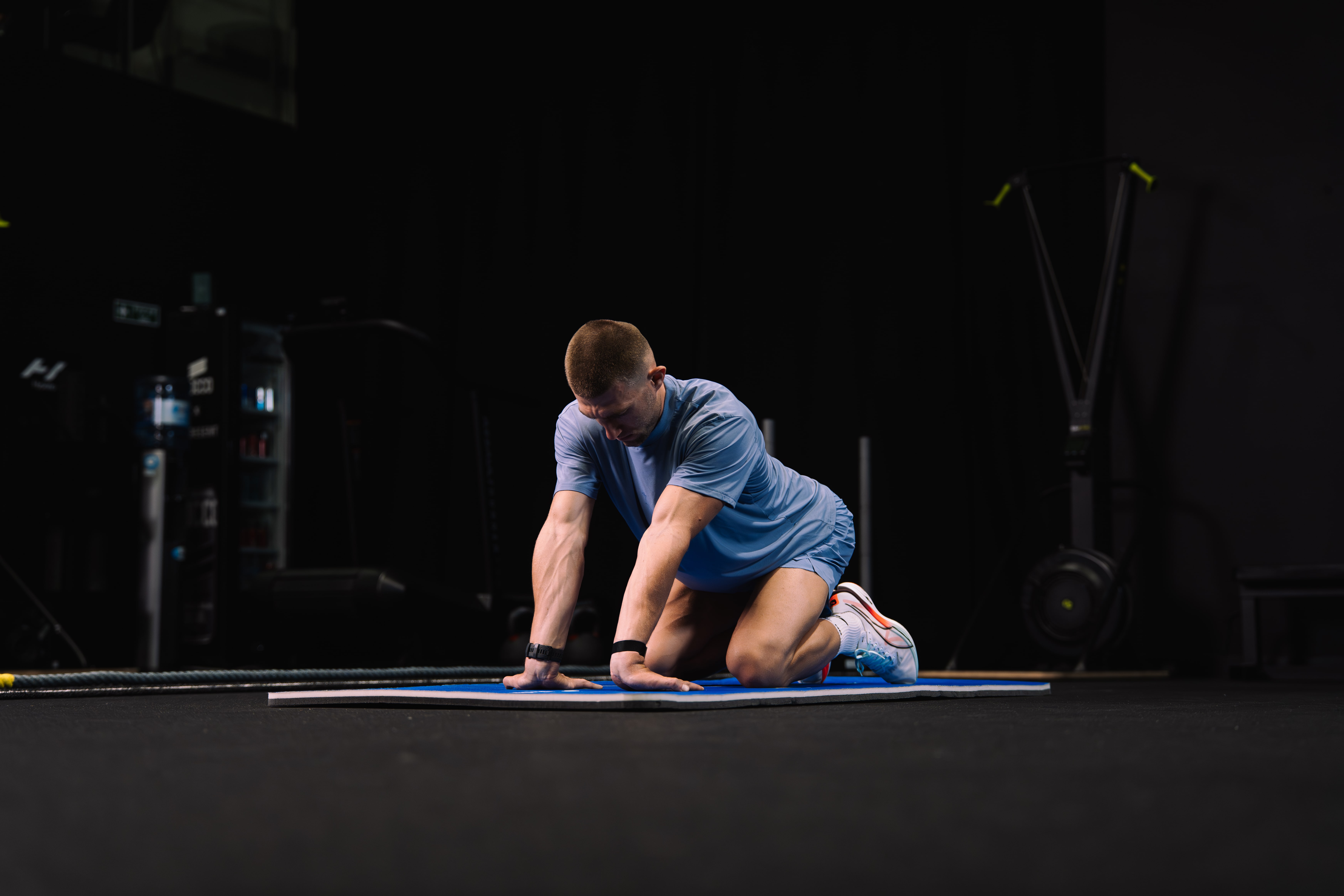
Kneel on the floor and sit back on your ankles. If this bothers your knees, place a pillow or folded blanket between your ankles and bottom. Lean forward, place your hands on the floor, and stretch your arms in front of you. Rest your head between your arms and gently push your chest toward the floor. Hold for 15 to 30 seconds. Repeat two to four times.
Why is the child's pose effective for back relief?
Child's pose combines spinal flexion with shoulder flexion, creating gentle traction through your entire back. It activates your diaphragm and encourages deeper breathing, which calms your nervous system and reduces the protective muscle guarding that contributes to chronic stiffness. Use this position as a reset between challenging exercises or to check in with your body's current state. Day-to-day variations in how the stretch feels indicate how well your recovery strategies are working.
Shoulder Roll
Stand or sit upright with your chin slightly tucked and arms relaxed. Roll your shoulders up, back, and down in a smooth circle, then forward. Repeat two to four times, then reverse direction for two to four more repetitions.
This drill resets your shoulder blade position and reminds your nervous system what full shoulder mobility feels like. Most people spend hours with their shoulders rolled forward and elevated. Shoulder rolls move your shoulder blades through their full range of motion in all directions, counteracting that pattern. Perform them every hour during desk work to interrupt static positioning, which can cause stiffness.
How do you perform wall push-ups correctly?
Stand facing a wall with your feet 12 to 24 inches away. Place your hands on the wall at shoulder height, slightly wider than shoulder-width apart, with fingers turned out slightly. Bend your elbows and bring your face toward the wall, keeping your shoulders and hips aligned. Push back to the starting position with controlled movement. Repeat eight to twelve times.
What benefits do wall push-ups provide?
Wall push-ups strengthen your chest, shoulders, and shoulder blade muscles without the stress of floor push-ups. They teach your shoulder blades to stay stable against your ribcage during the push, preventing them from winging out and overworking your upper back muscles. This helps prevent neck and upper back pain. You can progress by moving to a counter, then a sturdy chair, and finally to the floor. Each step increases the load on your stabiliser muscles while maintaining the same pushing movement.
How do you perform the resisted shoulder-blade squeeze?
Sit or stand while holding an exercise band in both hands in front of you. Keep your elbows close to your sides, bent at 90 degrees, with your palms facing up. Squeeze your shoulder blades together and move your hands outward to stretch the band. Keep your elbows pinned to your sides throughout the movement. Slowly return to the starting position. Repeat eight to twelve times.
Why does adding resistance improve shoulder blade strength?
This exercise focuses on the retraction movement you practised earlier, but adds resistance to build strength. Stronger rhomboids and middle traps reduce the load on your upper traps and neck. The band provides constant tension, forcing your stabilisers to work through the entire range of motion.
Choose a band resistance that allows you to complete twelve repetitions with good form. If your shoulders elevate or your elbows drift away from your sides, reduce the resistance.
How do you perform the resisted row exercise?
Anchor an exercise band at waist level around a solid object like a bedpost or handrail. Stand or sit with your back to the anchor point, holding one end of the band in each hand. Extend your arms in front of you with tension on the band. With your shoulders relaxed, pull the band back, moving your shoulder blades toward each other as your elbows pass along your waist. Slowly return to the starting position. Repeat eight to twelve times.
What muscles does the resisted row strengthen?
Rowing movements strengthen the muscles that pull your shoulder blades down and back, counteracting the forward, raised position most people hold while at a desk. This exercise works your latissimus dorsi and posterior deltoids, creating balanced strength across your upper back. Start the pull with your shoulder blades, not your arms. Your hands are hooks.
How can structured mobility routines improve your results?
Most people treat mobility work as an afterthought, something to address when pain becomes severe. Platforms like Pliability shift this approach by integrating guided mobility routines into daily wellness habits, making movement quality a priority rather than a reaction. Structured video routines targeting specific restrictions and building measurable progress differ fundamentally from random stretching: the difference between quick relief and lasting change.
How do you measure improvement effectively?
To measure improvement, establish specific benchmarks. Note your current range of motion during thoracic rotation by marking how far your hand reaches behind you in the book opener position. Record how many scapular retractions you can perform before your upper traps start compensating. Track whether your stiffness decreases within the first week or takes two to four weeks to shift noticeably. These data points reveal whether your routine is working or needs adjustment.
Why does consistency matter more than intensity?
Doing things consistently matters more than doing them intensely. Performing these exercises three times per week with full attention produces better results than daily sessions done distractedly. Take a movement break every hour during work: even two minutes of shoulder rolls and scapular retractions prevents the static positioning that allows stiffness to accumulate.
Knowing the exercises helps only if you organize them into a sustainable routine that fits your actual life.
Relieve Upper Back Stiffness and Improve Mobility Today
If upper back stiffness is limiting your posture, workouts, or daily comfort, targeted mobility training can make a measurable difference. Most people struggle to maintain routines without structure or accountability. Guided programming shifts effort from sporadic to systematic progress.
🎯 Key Point: Pliability's mobility app provides daily routines designed to loosen tight muscles, improve thoracic spine mobility, and restore range of motion through guided video instruction. Our body scanning feature identifies which areas need the most attention—your upper back, shoulders, or compensatory patterns in your neck and hips. Instead of guessing which exercises to perform, you follow expert-designed sequences that address the specific restrictions driving your stiffness.
"Targeted mobility training can make a measurable difference in restoring pain-free movement and improving daily comfort." — Pliability Research Team
💡 Tip: Our platform's library adapts to your schedule, making mobility work accessible whether you have five minutes between meetings or thirty minutes for a full recovery session. Start your seven-day free trial today on iPhone, Android, tablet, or web and begin restoring the flexibility and pain-free movement your upper back was designed to provide.
Related Reading
Finger Stiffness And Locking Treatment
Muscle Stiffness Treatment
Hip Stiffness Exercises
How To Get Rid Of Neck Stiffness
How To Reduce Stiffness After an Ankle Sprain
Stretches For Lower Back Stiffness
Left Arm Stiffness
Hand Stiffness Exercises
Best Supplements For Muscle Pain And Stiffness
How To Relieve Morning Back Stiffness











Move better in 10 minutes a day.
10,000+ five-star reviews.