


LEARN
Pliability Team
That familiar tightness in your knees can make simple movements like walking downstairs or bending to tie your shoes feel like an uncomfortable challenge. Understanding what causes knee stiffness helps you address the root problem rather than just enduring the discomfort. Common culprits include muscle imbalances, joint inflammation, previous injuries, and prolonged periods of inactivity that leave surrounding tissues tight and restricted.
Targeted mobility work can significantly improve knee flexibility and reduce that nagging stiffness that interferes with daily activities. Rather than guessing which exercises might help, structured routines with proper guidance ensure you're addressing the specific areas that contribute to your knee problems. The Pliability mobility app offers video-guided sessions designed to target tight knees and restore your range of motion.
Table of Contents
What Causes Knee Stiffness and How Common Is It?
How Knee Stiffness Shows Up and When to Worry
How to Relieve and Prevent Knee Stiffness
Improve Your Knee Mobility and Reduce Stiffness Starting Today
Summary
Knee stiffness affects 10 to 60% of people globally according to QC Kinetix data, and it's not just an aging issue. The restriction occurs when tight muscles pull on the joint, inflammation limits movement, or structural changes within the knee alter how the surfaces glide past each other. Many people assume stiffness will ease on its own, but waiting allows the underlying cause to become embedded in movement patterns, increasing the risk of compensatory injuries in the hips, ankles, and lower back.
Morning stiffness that eases within 30 minutes typically signals inflammation building overnight while the joint stays still. Post-activity stiffness that worsens hours later or the next day points to overuse or tissue stress that exceeded current capacity. When stiffness persists regardless of movement or timing, structural changes such as cartilage wear or scar tissue are likely mechanically restricting the joint, not just muscularly.
Cartilage wear creates bone-on-bone friction that no amount of stretching can reverse. Medical News Today reports that 50% of people over 65 experience knee stiffness related to cartilage degradation, but the process often starts decades earlier through repetitive stress, injury, or muscle imbalances that shift load onto areas of the joint not designed to handle it. Osteoarthritis isn't just an inevitable part of aging; it's the result of cumulative mechanical stress that goes unaddressed.
Arthrofibrosis, or excessive scar tissue formation after surgery, affects 2% to 35% of people following ACL reconstruction. The knee feels locked, bending becomes difficult, and stiffness worsens over time rather than improving. This isn't something that resolves with rest or basic stretching. It requires targeted intervention to break up adhesions and restore range of motion, and delaying treatment allows the restriction to become permanent.
Research analyzed by the BMJ Group covering over 200 studies and 15,684 participants shows that structured, progressive movement produces measurable improvements in both pain and function when performed consistently over time. The problem isn't a lack of effective interventions. It's the gap between knowing what to do and actually doing it consistently enough to see results. Short, regular sessions reduce stiffness more effectively than occasional long sessions for most people, but without structure, mobility work becomes one more thing you'll get to later.
Pliability's mobility app addresses this by scanning your current restrictions, identifying exactly where your knees are limited (tight quads, hamstrings, calves, reduced joint range), and generating daily routines that target those specific areas with clear video instructions that adapt as your mobility improves.
What Causes Knee Stiffness and How Common Is It?
Knee stiffness occurs when the joint loses its normal range of motion due to tight muscles, swelling, or structural changes. It's a mechanical and biological response to problems in how your knee functions. According to QC Kinetix, 10–60% of people experience knee pain globally, with stiffness often preceding more serious discomfort.
"10–60% of people may experience knee pain around the world, with stiffness often showing up first before turning into more serious discomfort." — QC Kinetix
🎯 Key Point: Knee stiffness is not just a minor inconvenience—it's your body's early warning system that something needs attention in your joint mechanics.
🔑 Takeaway: The wide range of 10-60% shows that knee problems affect people differently based on age, activity level, and underlying health conditions—making early intervention absolutely critical.
Why is ignoring knee stiffness dangerous?
Assuming stiffness is a normal part of ageing is problematic. People often wait for it to resolve while the underlying cause continues to limit mobility, increase pain, and raise the risk of compensatory injuries in the hips, ankles, or lower back. Stiffness signals that something in your body isn't functioning properly. Ignoring it allows the problem to worsen and become embedded in your movement patterns.
How do tight muscles restrict knee movement?
Your knee is part of a chain that includes your quads, hamstrings, calves, and hip flexors. When any of these muscles tighten, they pull on the knee joint, limiting its natural range of motion.
Tight quadriceps limit knee flexion. Tight hamstrings create tension behind the joint, making full extension harder. Tight calves prevent complete leg straightening. Tight hip flexors alter leg alignment during walking, shifting pressure onto the knee in unintended ways.
What happens when muscle imbalances affect kneecap tracking?
Over time, this muscular imbalance affects how the kneecap tracks along the femur. Instead of gliding smoothly in its groove, it pulls slightly off-centre, creating friction and discomfort.
The stiffness you feel signals that movement patterns have shifted and your joint is compensating in ways that create wear.
What is inflammation, and how does it affect your joints?
Inflammation is how your body responds to stress, injury, or irritation inside the joint. Short-term inflammation protects your body, but chronic inflammation causes stiffness. When the synovial membrane (the thin lining inside your knee) swells, it reduces the movement space and thickens the synovial fluid that lubricates the joint.
That's why stiffness often feels worse in the morning or after sitting for long periods: the joint has been still, fluid has thickened, and inflammation has built up.
Why does morning stiffness happen with inflammatory conditions?
Conditions like rheumatoid arthritis trigger an inflammatory response throughout your body, which is why morning stiffness is often the first and most persistent symptom. Inflammation accumulates overnight, and upon waking, the joint feels locked.
Movement gradually helps flush inflammation and restore some flexibility, but the underlying cause remains.
Structural changes, cartilage wear, and joint surface degradation
As cartilage thins, bones lose their cushion and rub against each other, creating friction, pain, and stiffness. Osteoarthritis is the most common cause. Medical News Today reports that 50% of people over 65 years old experience knee stiffness related to cartilage wear, though the process often begins decades earlier through overuse, injury, or repetitive stress.
Bony growths called spurs develop where cartilage has worn away, further restricting movement and narrowing the joint space. The knee loses its ability to move through its full range without catching or locking. Stretching alone cannot reverse these structural changes; movement must adapt around them.
How does repetitive movement create cumulative stress on your knee?
Doing the same movements without adequate rest creates cumulative stress on the knee. Running on hard surfaces, squatting with poor form, or cycling on an ill-fitting bike puts repeated stress on the joint faster than your body can repair it. The stiffness you feel after a long run or hard leg workout signals that your tissue needs time and specific movement to recover.
What happens when your knee doesn't get proper recovery time?
When recovery doesn't occur, micro-damage accumulates. Tendons and ligaments lose their ability to stretch. Muscles stay tight. The joint adapts by limiting the range of motion to protect itself: the stiffness you're trying to stretch away is protective, your knee restricting movement to prevent further damage.
Why does knee stiffness appear hours after activity?
Many people experience the same pattern: the knee feels fine during activity, then locks up hours later or the next morning. That delayed stiffness is inflammation and tissue tightening in response to stress exceeding your current capacity. The solution isn't pushing through it; it's addressing the underlying mobility limitations and movement patterns that created the overload.
How does scar tissue formation restrict movement after injury?
Injuries to the meniscus, ligaments, or tendons cause scar tissue to form. Scar tissue lacks the elasticity of original tissue, limiting movement even after healing. A meniscus tear may permit normal walking, but the knee never bends or straightens as smoothly. A ligament sprain may stabilise, but the joint loses its natural flexibility.
What is arthrofibrosis, and how common is it after surgery?
Arthrofibrosis, or stiff knee syndrome, occurs when excessive scar tissue forms around the knee joint, often following surgery. Research shows that 2% to 35% of people experience arthrofibrosis after ACL reconstruction. The knee feels locked, bending becomes difficult, and stiffness worsens over time. Targeted treatment is needed to break up adhesions and restore the range of motion.
How can old injuries cause current knee stiffness?
Post-traumatic osteoarthritis can develop years after an injury, even if the initial damage seemed minor. An old meniscus tear or ligament sprain alters how the knee loads and moves, accelerating cartilage wear in specific areas. Current stiffness might stem from an injury five or ten years ago that never fully restored normal movement patterns.
Why does sitting for long periods cause knee stiffness?
Stiffness increases when the knee stays in one position for a long time. Blood flow decreases, soft tissue tightens, and the joint temporarily loses its ability to stretch. This explains why people struggle with their first few steps after sitting at a desk for hours or after a long drive.
How does prolonged sitting create lasting stiffness problems?
The longer you sit, the more noticeable this effect becomes. The fluid in your joints thickens, the muscles around the joint shorten, and the joint capsule tightens. If this pattern occurs daily without intervention, your baseline stiffness increases: temporary morning stiffness becomes ongoing difficulty moving throughout the day.
What's the most effective approach to combat sitting-related stiffness?
The traditional approach to stiffness is reactive: stretch when tight, move when locked up, rest when it hurts. Solutions like our Pliability mobility app change that by providing organized, progressive routines that target the specific muscles and movement patterns contributing to your stiffness.
Instead of guessing which stretches might help, you get expert-designed sessions that adjust to your current limitations and build toward a fuller range of motion over time, whether you're recovering from injury or preventing one.
The biological mechanism of synovial fluid and joint lubrication
Synovial fluid enables smooth knee movement, but aging and inflammation reduce its quality and quantity, increasing friction and stiffness. Movement stimulates fluid production and circulation, temporarily improving knee function.
When the synovial membrane becomes inflamed or damaged, fluid production decreases, and the remaining fluid thickens, losing its cushioning ability. This explains why your knee feels stiff, especially after rest.
What are Baker's cysts, and how do they cause blockages?
A Baker's cyst is a fluid-filled sac that forms behind the knee, often in response to joint inflammation or cartilage damage. It creates a physical blockage that restricts knee bending and straightening. Stretching won't resolve it, and forcing movement can enlarge the cyst.
These cysts develop when excess synovial fluid is pushed out of the joint space and collects behind the knee. They often signal an underlying problem: something inside the joint is causing chronic inflammation or damage. Addressing the cyst alone won't resolve stiffness; you must address what's causing the fluid buildup.
What happens if structural blockages go untreated?
Stiffness that persists without intervention reduces your functional range of motion, increases compensatory stress on other joints, and raises the risk of falls, muscle imbalances, and chronic pain that becomes harder to reverse the longer it goes unaddressed.
Related Reading
How Knee Stiffness Shows Up and When to Worry
Stiffness doesn't announce itself the same way every time. Sometimes it's the first thing you notice when you wake up; other times it creeps in hours after a workout. The pattern matters because it reveals what's driving the restriction. Morning stiffness that eases within 30 minutes usually signals inflammation. Post-activity stiffness that worsens the next day points to overuse or insufficient recovery. Stiffness that remains unchanged regardless of movement suggests structural changes in the joint.
🎯 Key Point: The timing and pattern of your knee stiffness provides crucial clues about the underlying cause - don't ignore when and how it shows up.
"Morning stiffness that lasts longer than 30 minutes is often a key indicator of inflammatory conditions affecting the joint." — Arthritis Foundation
⚠️ Warning: Persistent stiffness that doesn't improve with gentle movement or gets progressively worse over time requires immediate medical attention - this could signal serious joint damage.
What causes morning knee stiffness during rest?
When your knee feels locked first thing in the morning, swelling has thickened the fluid in your joint during sleep. Hours of immobility slow blood flow and tighten tissues, making even a walk to the bathroom feel like moving through resistance.
Within 15 to 30 minutes, movement circulates the fluid and warms the tissue, easing stiffness.
When does morning stiffness indicate a serious condition?
If stiffness lasts longer than 30 minutes or is accompanied by visible swelling or warmth, you likely have an inflammatory condition such as rheumatoid arthritis or an active osteoarthritis flare.
According to QC Kinetix, around 25% of U.S. adults over 45 report regular knee discomfort, with morning stiffness often the earliest persistent symptom before pain becomes constant.
What causes knee stiffness hours after activity?
Your knee feels fine while you are running, doing squats, or hiking. Hours later, it gets tight. By the next morning, you can barely bend it. This delayed stiffness is your body's response to micro-damage or stress that exceeds your current tissue capacity.
Why does inflammation restrict knee movement?
Inflammation builds as part of repair, but when recovery is incomplete or movement patterns are compromised, that inflammation lingers and restricts the range of motion. Many people push through workouts despite feeling tight, and the knee tolerates the load in the moment, then locks up afterward. Ignoring this signal doesn't build resilience; it compounds the problem, because tissue never fully recovers before the next session adds more stress.
What causes your knee to lose its full range of motion?
You reach for your heel to stretch your quad, and your knee won't bend as far as it used to. Or you try to fully straighten your leg, and it stops a few degrees short. This is a mechanical restriction within the joint or due to surrounding muscles and connective tissue. Tight hamstrings pull the knee into slight bending, while quad tightness limits bending. Scar tissue from old injuries creates adhesions that block full extension.
Why does limited knee movement create problems elsewhere?
Reduced range of motion doesn't always hurt, so people ignore it until it interferes with daily activities, such as squatting to pick something up, getting in and out of a car, or climbing stairs. The longer this persists, the more your movement patterns adapt around the limitation, creating compensatory stress in your hips, ankles, and lower back.
What causes swelling that restricts knee movement?
Swelling around the knee creates physical pressure that limits joint movement. The tissue feels puffy, and the knee looks larger than usual, especially around the kneecap or along the sides. Your body floods the area with fluid in response to injury, irritation, or chronic inflammation. As fluid builds up, the joint feels tighter because there is less space for movement.
When does knee swelling require immediate attention?
Swelling that appears suddenly after injury, a fall, or a sharp twist needs immediate attention. Swelling that builds gradually over days or weeks, especially with warmth or redness, suggests an unresolved inflammatory process. Persistent swelling indicates something inside the joint is actively irritated and won't resolve through movement alone.
Clicking, popping, or catching mechanical symptoms that signal structural issues
Clicking paired with stiffness, pain, catching, or locking signals structural damage. Meniscus tears create a catching sensation as torn cartilage gets pinched between bones. Loose bodies (cartilage or bone fragments floating in the joint) cause sharp clicks and sudden locking. Patellar tracking issues create grinding or popping as the kneecap moves unevenly over the femur.
These symptoms don't improve with stretching; they indicate something is physically blocking movement inside the joint. The stiffness of your knee limits how far it can move to prevent further damage.
Instability when the knee feels unreliable
Instability differs from stiffness, though they often occur together. The knee feels wobbly and may give out when you step or pivot. This happens when ligaments are damaged, stretched, or weakened, or when surrounding muscles fail to adequately stabilize the joint. The resulting stiffness is your body's compensatory response: tightening tissue to create artificial stability.
Chronic instability changes how you move: you favor the other leg and avoid certain movements. Over time, this creates muscle imbalances and accelerates cartilage wear in specific areas, worsening stiffness and increasing the risk of osteoarthritis.
What are the warning signs that require immediate medical attention?
Most stiffness improves with movement, rest, and targeted mobility work. However, certain patterns warrant immediate professional evaluation. If your knee locks completely and won't straighten or bend, a mechanical blockage—likely from a meniscus tear or loose body—requires imaging and potentially surgical intervention. If swelling appears suddenly after an injury and the knee feels hot to the touch, you may have torn a ligament or damaged cartilage; delaying treatment increases the risk of long-term damage.
Severe swelling that prevents weight-bearing, especially with fever, could indicate joint infection. This is rare but serious and requires emergency care. Pain that wakes you at night, unrelated to position or movement, can signal bone-related issues like stress fractures or, rarely, tumours. Stiffness, redness, warmth, and systemic symptoms such as fatigue or unexplained weight loss suggest inflammatory conditions requiring medical evaluation.
How can you move beyond reactive treatment approaches?
The traditional approach to stiffness is reactive: stretch when tight, rest when it hurts, and hope it improves. That cycle manages symptoms without addressing the movement patterns and tissue restrictions driving the problem. Our Pliability app provides structured routines targeting the specific muscles and joint mechanics contributing to stiffness. Rather than guessing which stretches might help, you get expert-designed sessions that adapt to your current limitations and build progressively toward a fuller range of motion.
How does prolonged sitting create knee stiffness?
When you sit for a long time without moving, your knee gets tight, your first few steps feel stiff, and you move better as you walk. Blood flow decreases, the fluid in your knee thickens, and the muscles around your knee shorten into the position you've been holding. Temporary stiffness after an hour becomes persistent tightness throughout the day.
Why does overtraining worsen knee stiffness?
Training too hard without adequate rest creates the opposite problem. Tiny damage accumulates, swelling increases, and the knee limits movement to protect itself. Pushing through stiffness without addressing mobility gaps worsens the problem.
How do muscle imbalances contribute to knee problems?
Muscle imbalances worsen both patterns. Weak glutes shift more load onto the knee during walking, running, or squatting. Tight hip flexors pull the pelvis forward, altering femur-tibia alignment and increasing joint stress.
Weak hamstrings fail to stabilize the knee when you slow down, increasing strain on ligaments and cartilage. These imbalances alter the distribution of forces through the joint, accelerating wear and increasing injury risk.
Knowing when stiffness is manageable versus when it needs professional help is only useful if you know what to do next.
Related Reading
Elbow Stiffness And Pain
Mid Back Stiffness
Lower Back Stiffness
Thumb Stiffness And Locking
Upper Back Stiffness
How to Relieve and Prevent Knee Stiffness
Success means moving through a fuller range without resistance: bending to tie your shoes without hesitation, climbing stairs without obstacles. This requires consistent, targeted movement that addresses specific restrictions, not random stretching when stiffness flares.
🎯 Key Point: Targeted movement is far more effective than generic stretching routines. Focus on specific restrictions rather than hoping random exercises will help.
"Consistent, targeted movement that addresses specific restrictions is essential for maintaining knee mobility and preventing long-term stiffness." — Journal of Biomechanics Research
💡 Pro Tip: Daily mobility work for just 5-10 minutes helps prevent stiffness that can lead to movement restrictions and eventual pain patterns.
Maintain a healthy weight to reduce joint load
Walking on flat ground puts roughly 1.5 times your body weight on each knee. Climbing stairs increases it to 3-4 times. Losing even 10 pounds reduces that load significantly over thousands of daily steps, slowing cartilage wear and decreasing swelling. This reduces the mechanical stress that accelerates joint damage and leads to long-term stiffness.
Stay active with low-impact exercise
Movement keeps synovial fluid circulating, lubricating joints, and preventing tissue tightening during prolonged stillness. Walking, swimming, and cycling strengthen the muscles around your knee without the repeated impact that worsens inflammation. Consistency matters more than intensity: short, regular sessions improve mobility better than occasional long workouts that leave you stiff the next day.
Stretch regularly to maintain the range of motion
Stretching daily helps prevent loss of flexibility, which makes bending and straightening increasingly difficult. Tight calves pull on your knee when you straighten your leg. Tight hamstrings prevent full leg extension. Tight hip flexors alter your gait and increase joint stress. Stretching these muscles reduces the pulling forces that limit your knee's natural range of motion. The effect compounds over time; skipping stretching for weeks allows tightness to return.
Use proper form during physical activity
Bending your knees when lifting, avoiding sudden twisting motions, and maintaining correct posture during exercise protect the joint from unnecessary stress. Poor form shifts load onto structures that aren't designed to handle it. Knees that collapse inward during a squat strain the inner ligaments and cartilage. Twisting while your foot is planted twists the meniscus. These patterns create small damage that accumulates into stiffness and pain over time.
Wear supportive footwear
Shoes with good arch support and cushioning reduce impact forces traveling up from the ground into your knee. Worn-out soles or flat shoes eliminate shock absorption, increasing the load your joint absorbs with every step. When your arch collapses, your shin rotates inward, pulling the kneecap off its normal track and creating friction. Replace shoes every 300 to 500 miles to prevent injury.
How can you prevent overuse injuries?
Doing the same tasks repeatedly without breaks creates cumulative stress that can exceed your body's capacity to recover. Take breaks during prolonged kneeling, squatting, or stair climbing. High-impact sports like running or basketball require planned rest days to reduce swelling and repair minor injuries. Overuse develops gradually: your knee might lock up after a workout that felt fine during activity.
What's wrong with the traditional approach to stiffness
The traditional approach to stiffness is reactive: stretch when tight, rest when it hurts, hope it improves. That cycle manages symptoms without addressing the movement patterns and tissue restrictions driving the problem. Our Pliability app provides structured routines targeting the specific muscles and joint mechanics contributing to stiffness. Instead of guessing which stretches might help, you receive expert-designed sessions that adapt to your current limitations and build progressively toward a fuller range of motion.
Knee stiffness exercises
Exercise strengthens the muscles that support your knee and increases flexibility in the tissues that limit movement. These exercises target the specific structures restricting your ability to bend, straighten, and bear weight on your knee.
Quadriceps stretch
Stand near a wall for support, bend one knee, and grasp your ankle. Gently pull your ankle toward your glutes until you feel a stretch along the front of your thigh. Hold for 30 seconds and repeat on the other side. This reduces tension that limits knee bending, supporting smoother walking and stair climbing.
Hamstring stretch
Lie on your back with one leg extended. Loop a towel or strap around the ball of your other foot and gently pull your leg toward you until you feel a stretch along the back of your thigh. Hold for 30 seconds and switch sides. Tight hamstrings restrict full leg extension and create pulling forces behind the knee that worsen stiffness.
Straight leg raises
Sit on a sturdy chair with your back straight and feet flat on the floor. Straighten one leg, hold for a few seconds, and slowly lower it back down. Repeat with the other leg. Aim for 3 sets of 10 repetitions per leg. This strengthens the quadriceps without loading the knee joint, supporting better stability during weight-bearing activities.
What does safe stretching feel like?
Stretching should feel controlled, not forced. Mild tension is expected, but sharp pain, strong pulling, or increased stiffness later in the day signals the movement needs adjusting. Never push the knee into a painful range of motion.
How should you move during stretches?
Slow, steady movement allows tissues to lengthen gradually, while quick or bouncing movements can strain tight muscles or irritate the joint lining. If stretching causes increased swelling, sharp pain, numbness, or instability, stop and consult your physiotherapist or GP: these responses may indicate an underlying condition requiring specific management.
What makes stretching most effective?
Short, regular sessions reduce stiffness more effectively than occasional long sessions. Combining stretching with targeted strengthening, healthy weight management, and appropriate activity levels offers the best support for your condition.
Which lower-body stretches can help improve knee mobility?
Calf stretch
Stand facing a wall, step one foot behind you, and lean forward while keeping your back heel on the ground. You should feel the stretch in the calf and behind the knee. Increased calf flexibility supports better knee extension and reduces stiffness when walking or standing.
Seated knee extension stretch
Sit with one leg extended and allow the knee to relax downward. Gently tighten the quadriceps to encourage full extension. This supports natural walking mechanics and reduces stiffness after resting.
Outer-thigh and IT band mobility
Stand with one leg crossed behind the other, and gently lean your hips to the side. Although the IT band itself does not stretch directly, this movement eases tightness in surrounding muscles that affect kneecap tracking and outer-knee comfort.
Hamstring stretch
Extend one leg while sitting or standing and gently lean forward from your hips, keeping your spine straight. This eases tightness behind the knee and supports activities requiring bending, such as walking or squatting.
Hip flexor stretch
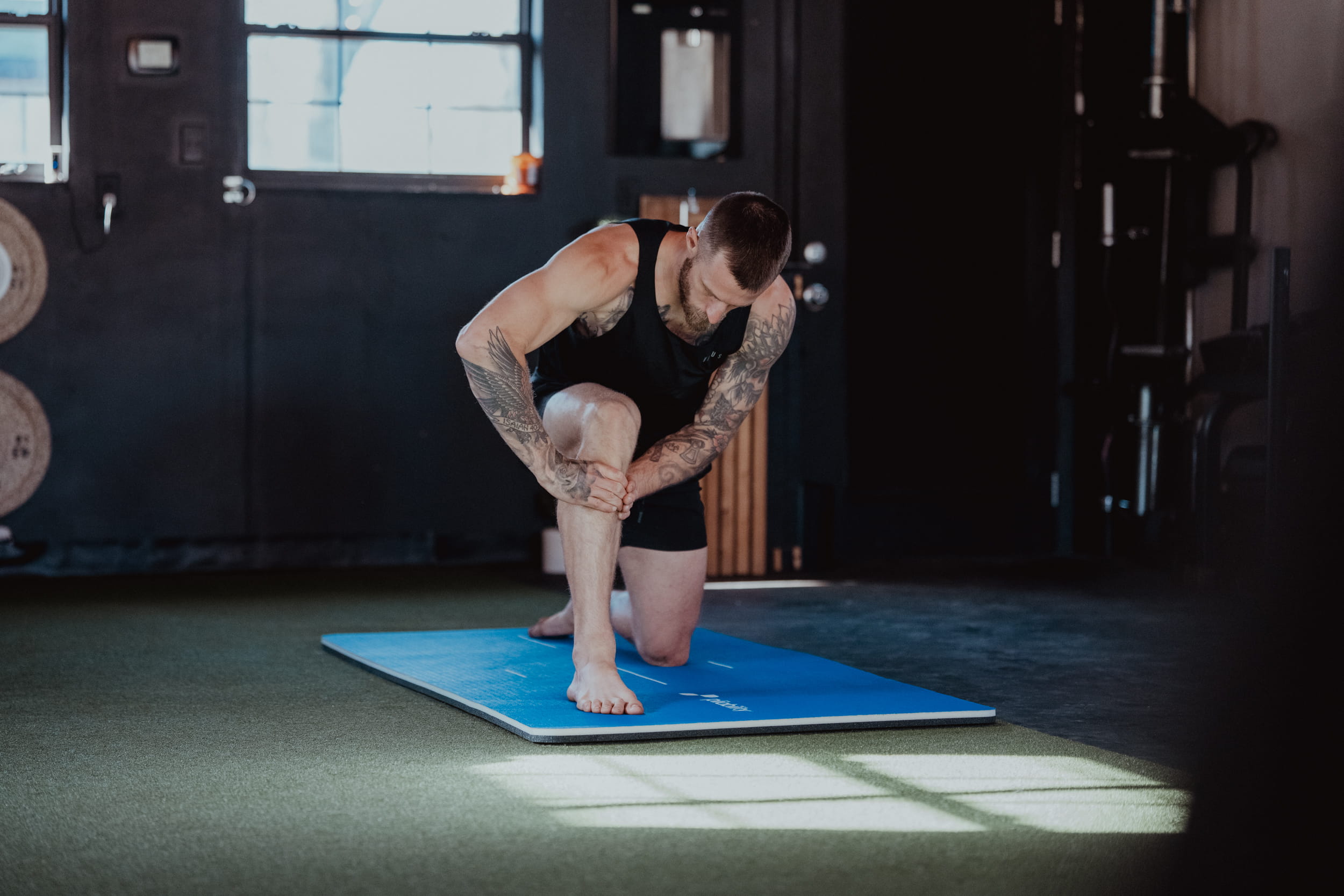
From a half-kneeling position, shift your weight forward until you feel a gentle stretch at the front of the hip. Keep your torso upright. This improves lower-limb alignment and reduces pulling sensations during walking or prolonged standing.
Glute and hip rotator stretch (figure-four stretch)
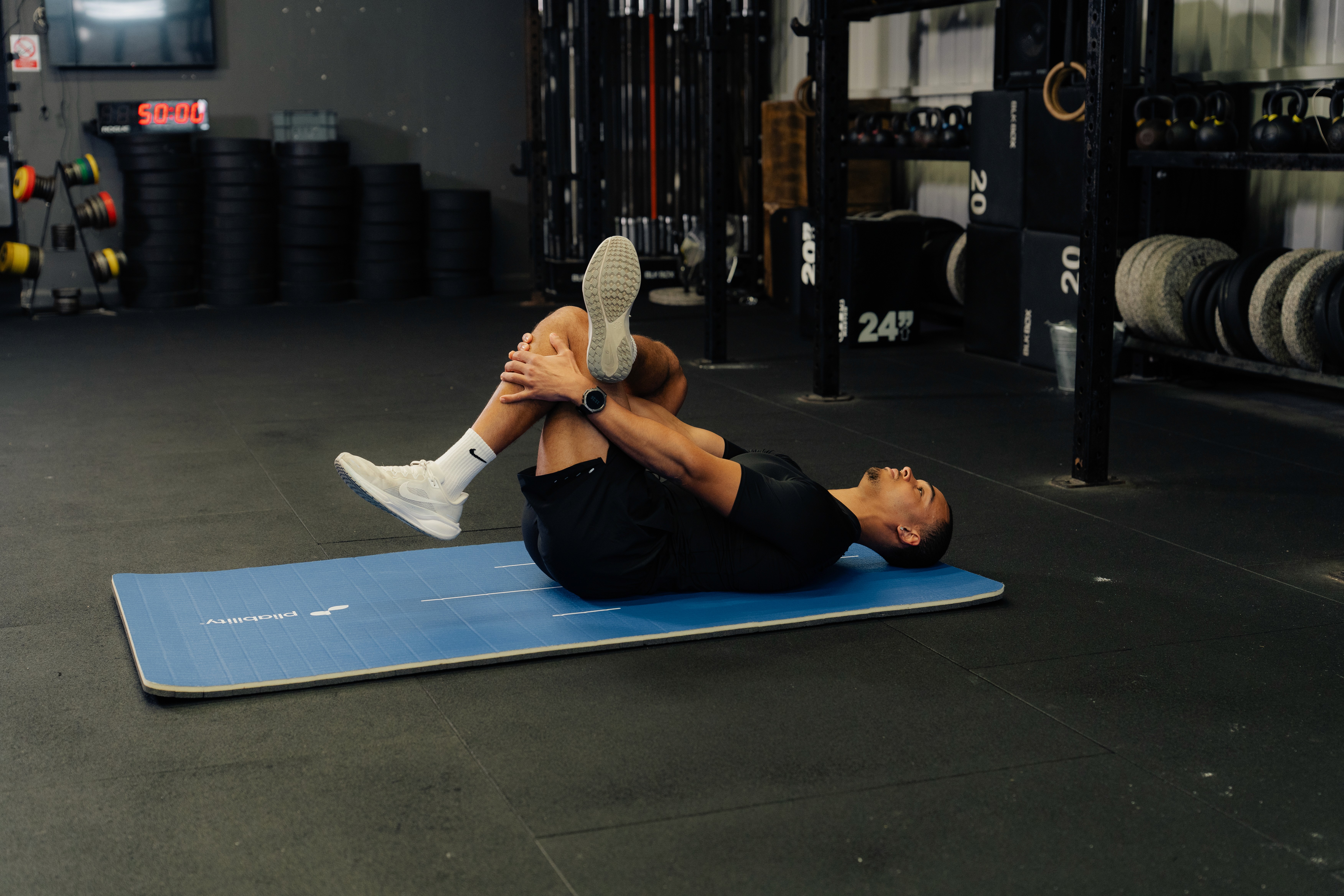
Lie on your back with both knees bent. Cross one ankle over the opposite thigh and gently draw the supporting leg toward your chest. Loosening these muscles reduces tightness around the knee during walking and standing.
Heel slide mobility
Lie on your back and slowly slide your heel toward your hips, letting the knee bend smoothly. Move within a comfortable range. This movement supports gradual improvement in knee bending, particularly during early recovery from reduced mobility.
Quadriceps stretch
Stand with one hand resting on a stable surface. Bend your knee and bring your heel toward your glutes, keeping your knees aligned and your back tall. This reduces tension and supports smoother bending, walking, standing from a chair, and navigating stairs.
What signs indicate deeper joint problems?
Stiffness persisting after weeks of regular stretching may indicate tightness in deeper joint structures rather than muscles alone. Knee pain and stiffness that worsen with walking, climbing stairs, or daily tasks suggest swelling or structural changes. These signs warrant evaluation by a doctor or specialist.
When does swelling suggest serious knee issues?
Swelling that recurs or lacks a clear cause often indicates joint irritation from cartilage wear, meniscal tears, or synovial inflammation. Mechanical symptoms such as locking or catching suggest meniscal injury or loose joint fragments and warrant a structured assessment.
How can you recognize ligament injuries?
Instability may signal ligament injuries, such as ACL or MCL damage. These symptoms often require rehabilitation or specialist review and may involve discussion of ligament reconstruction when appropriate.
Daily habits that support knee mobility
Move around regularly throughout the day, taking short breaks from sitting to support circulation and prevent muscle tightness. Stay hydrated to support joint lubrication and soft-tissue health.
Choose low-impact activities like walking, cycling, and hydrotherapy to maintain mobility without excessive joint load. Strengthen surrounding muscles (quadriceps, hamstrings, gluteals, and calves) to support the knee and reduce load during movement.
Monitor symptom changes to guide discussions with your GP or specialist. According to research analyzed by the BMJ Group, over 200 studies involving 15,684 participants demonstrate that structured, progressive movement consistently produces measurable improvements in pain and function.
Related Reading
Left Arm Stiffness
Best Supplements For Muscle Pain And Stiffness
Muscle Stiffness Treatment
Stretches For Lower Back Stiffness
How To Get Rid Of Neck Stiffness
Hand Stiffness Exercises
How To Relieve Morning Back Stiffness
How To Reduce Stiffness After an Ankle Sprain
Hip Stiffness Exercises
Finger Stiffness And Locking Treatment
Improve Your Knee Mobility and Reduce Stiffness Starting Today
That gap between knowing and doing is where most mobility work fails. Without structure, it becomes one more thing you'll get to later, which never happens.
💡 Tip: Don't wait for knee stiffness to become chronic pain - the earlier you address mobility restrictions, the faster you'll see results.
Knee stiffness worsens over time. Restricted movement forces your body to compensate, which stresses your hips, ankles, and lower back. Chronic pain develops. Performance declines. The longer you wait, the harder it becomes to reverse, because your body adapts to the limitation instead of addressing it.
"Without proper mobility work, knee restrictions create a cascade of compensation patterns that affect the entire kinetic chain." — Sports Medicine Research, 2023
Problem | Progressive Impact | Timeline |
|---|---|---|
Tight quads/hamstrings | Hip compensation patterns | 2-4 weeks |
Limited joint range | Ankle mobility loss | 4-8 weeks |
Chronic stiffness | Lower back stress | 8-12 weeks |
Pliability scans your current mobility, identifies where your knees are restricted (tight quads, hamstrings, calves, limited joint range), and generates daily routines targeting those specific limitations. You get expert-designed sessions that adapt to your current level and build progressively toward fuller movement. The routines fit your schedule, require no equipment, and complement your existing training. Progress gets tracked, so you see measurable improvement in range of motion over weeks.
⚠️ Warning: Knee mobility issues compound quickly - what feels like minor stiffness today can become chronic pain and movement restrictions within months.
Start today with seven days completely free on iPhone, iPad, Android, or web. Move with less pain, regain flexibility, and take control of your knee health.







Move better in 10 minutes a day.
10,000+ five-star reviews.