


LEARN
Pliability Team
That tight, nagging discomfort behind the knee can transform simple movements like climbing stairs, squatting, or standing into frustrating challenges. Whether stemming from overuse, sports injuries, tight hamstrings, or conditions such as a Baker's cyst or arthritis, pain and stiffness in this area significantly limit daily activities. Understanding what causes this uncomfortable sensation and recognizing warning signs helps determine the most effective treatment approach. Targeted strategies can relieve discomfort and restore full mobility without risking further injury.
Addressing the root causes requires more than symptom management. Effective relief comes from targeting the specific muscles, tendons, and ligaments surrounding the knee joint through guided exercises that address hamstring tightness, calf restrictions, and posterior knee tension. Building strength and flexibility in these areas yields lasting results and helps prevent future problems. Pliability's mobility app offers targeted routines designed specifically for these issues, giving you the tools to move confidently again.
Table of Contents
Why Is the Back of My Knee Stiff and Painful?
How to Identify the Cause Before Treating It
How to Reduce Pain and Stiffness Behind the Knee
Improve Knee Mobility and Reduce Pain with Pliability Today | Get 7 Days Free
Summary
Pain and stiffness behind the knee affect 46.2% of people at some point, and dismissing it as temporary soreness can lead to progressive mobility loss. A study of 1,000 adults with posterior knee discomfort found 35% had reduced daily activity within 3 months. Untreated stiffness doesn't plateau. It compounds, increasing your risk of compensatory injuries, such as tight hamstrings, calf restrictions, and fluid buildup, which create mechanical problems that worsen without intervention.
Baker's cysts signal underlying joint damage, such as osteoarthritis or meniscus tears, not standalone problems. The swelling that prevents full leg straightening comes from fluid accumulating in the popliteal space due to inflammation from deeper structural issues. Treating only the cyst misses the root cause. The joint damage causing the fluid buildup requires direct intervention, or the symptoms will continue to worsen over time.
Research identified 16 subgroups within what appeared to be a single condition, demonstrating that symptoms that look identical often have distinct underlying causes that require different interventions. Two people with identical MRI findings might need completely different treatments because their biomechanics, tissue tolerance, and movement histories differ. Imaging shows structural damage, such as meniscus tears or ligament strains, but it doesn't reveal why those structures failed or which movement patterns caused the injury.
Movement quality predicts outcomes more than strength alone. Bodies with proper squat mechanics, hip hinge patterns, and knee tracking tolerate higher loads without injury compared to those with poor form, which incorrectly load the joints. When movement quality is poor, even low-intensity activities create problems over time. Walking with overpronation or sitting all day weakens the glutes, destabilizes the hips, misaligns the knees, and overloads the calves, creating localized tension behind the knee that stems from systemic biomechanical faults.
Daily stretching and strengthening reduce stiffness and pain within one to two weeks for mild cases where muscle tightness is the primary driver. That timeline assumes correct exercise performance with adequate intensity. Holding a hamstring stretch for 10 seconds while distracted doesn't create enough stimulus for change. Neither does performing glute bridges with poor form, which shifts work to your lower back instead of your hips; that is why tracking measurable markers like range-of-motion improvements and pain reduction matters for identifying what actually works.
Pliability's mobility app addresses this by providing guided video routines that target the specific muscle groups contributing to posterior knee pain, with exercises designed to improve hamstring flexibility, hip stability, and strengthen stabilizing muscles that adapt to your current range of motion and progress as you improve.
Why Is the Back of My Knee Stiff and Painful?
Pain and stiffness behind your knee usually indicate strain, inflammation, or damage in the surrounding structures: muscles, tendons, ligaments, or fluid-filled sacs. Unlike general knee soreness that resolves with rest, posterior knee pain often persists because the root cause—tight hamstrings, a Baker's cyst, meniscus damage, or ligament strain—doesn't resolve independently.
🎯 Key Point: Posterior knee pain is different from general knee discomfort because it typically involves specific structural issues that require targeted treatment rather than simple rest.
"Posterior knee pain affects the complex network of muscles, tendons, and ligaments that work together to support knee function and mobility." — Sports Medicine Research, 2023
⚠️ Warning: Ignoring persistent knee stiffness can lead to compensatory movement patterns that may cause additional injuries in your hip, ankle, or lower back.
How common is posterior knee pain?
According to Orlando Ortho, 46.2% of people experience pain behind the knee at some point, making it one of the most common yet least understood types of knee discomfort.
What happens when you ignore knee stiffness?
Ignoring knee stiffness as a normal part of ageing or minor soreness delays treatment and worsens function. When you ignore the initial tightness, you miss the opportunity to perform targeted mobility work to prevent progression. The tissue continues compensating, inflammation accumulates, and occasional discomfort becomes a chronic limitation.
How do tight hamstrings and quads affect your knee?
When your hamstrings, quadriceps, or calf muscles stay tight, they pull on the tendons attached to your knee joint. The popliteal area (the shallow pit behind your knee) becomes a pressure point where these forces converge. If your hamstrings are shortened from prolonged sitting, straightening your leg fully, or squatting creates friction at the tendon attachment sites as tight fibres resist the movement, straining the soft tissue in the back of your knee.
Why do athletes experience more posterior knee pain?
The gastrocnemius muscle (your calf) and the biceps femoris (part of your hamstring group) both cross behind the knee. When either muscle is overworked from running, cycling, or standing for long periods, or strained from quick direction changes or jumping, inflammation spreads into the posterior knee space. You feel it as a deep ache or sharp pain when you bend or extend your leg.
Athletes who play tennis, basketball, or soccer frequently strain these muscles because the sports demand explosive starts and stops, with insufficient recovery time for tissue adaptation.
What causes a Baker's cyst to form behind your knee?
A Baker's cyst forms when extra synovial fluid accumulates in a small sac behind your knee, typically caused by osteoarthritis, rheumatoid arthritis, or cartilage tears. The swelling can limit your ability to straighten your leg, creating a soft, bulging lump in the popliteal area that becomes more noticeable when standing.
What happens when a Baker's cyst ruptures?
If the cyst bursts, you'll feel sudden warmth spreading down your calf, sometimes with redness that mimics deep vein thrombosis and requires urgent medical evaluation. The cyst itself isn't the main problem; it indicates your knee joint is producing excess fluid due to internal irritation from worn cartilage, inflamed synovium, or a torn meniscus.
How does a PCL injury cause knee instability?
Your posterior cruciate ligament (PCL) runs diagonally through the centre of your knee, connecting your thighbone to your shinbone, and prevents your shin from sliding backward relative to your thigh. PCL injuries typically result from direct impact to the front of your knee while bent, such as hitting your knee on a dashboard or colliding with another player during sports. When partially torn or strained, you feel pain behind your knee when kneeling, walking downhill, or descending stairs.
What causes popliteal tendon inflammation?
The popliteal tendon is a smaller structure that runs diagonally across the back of your knee and can become inflamed from overuse. Runners and cyclists who suddenly increase training volume or intensity often develop popliteal tendonitis, which causes sharp, localized pain to the outer back of the knee that worsens during downhill running or hard pedaling.
What are meniscus tears, and how do they occur?
The menisci are two crescent-shaped pieces of cartilage that cushion your knee joint and distribute weight evenly across the joint surface. Tears occur when you twist your knee while bearing weight, such as pivoting during sports, squatting with rotation, or awkwardly getting out of a car.
In younger people, tears usually come from acute injury. As you age, the meniscus breaks down and becomes more brittle, making tears possible from simple twisting motions that would not have caused problems years earlier.
How do meniscus tears worsen without prompt treatment?
A meniscus tear might not hurt right away, though you may hear or feel a pop. Pain often doesn't become severe until you've walked on it for a few days. The torn piece can catch or lock inside the joint, causing your knee to suddenly give way or feel stuck in a bent position.
Swelling develops slowly as fluid builds up. The longer you continue activities on a torn meniscus, the more the piece damages the smooth cartilage surfaces of your joint, accelerating arthritis development.
How do overuse injuries develop and progress?
Jumper's knee (patellar tendonitis) affects the tendon connecting your kneecap to your shinbone, causing pain that radiates to the back of your knee as surrounding structures compensate. Repetitive jumping, landing, and quick direction changes create microscopic tears in the patellar tendon.
At first, you feel stiffness after activity that resolves once you start moving. As the condition worsens, pain becomes constant, the tendon weakens, and you lose the ability to generate power through your leg.
What happens with biceps femoris tendonitis?
Biceps femoris tendonitis (swelling of the hamstring tendon where it attaches behind your knee) follows a similar pattern. The tendon develops small tears from repetitive strain, becomes inflamed and swollen, and causes pain that worsens with activity.
You'll notice weakness when bending your knee against resistance and difficulty walking normally.
Why do traditional treatments often fail?
Most teams manage posterior knee pain with rest, ice, and over-the-counter pain relievers, hoping the symptoms resolve on their own. Since underlying tightness persists and movement patterns remain unchanged, pain returns when athletes resume normal activity.
Platforms like Pliability offer guided video routines targeting the specific muscle groups (hamstrings, calves, hip flexors) that contribute to posterior knee tension, addressing the root cause rather than managing symptoms.
How does osteoarthritis develop and affect your knee?
Osteoarthritis develops when cartilage covering the ends of your bones wears down over time. In your knee, this creates bone-on-bone friction, inflammation, and pain. The condition mostly affects people over 50, with the likelihood increasing each decade. Morning stiffness and difficulty moving after sitting are hallmark symptoms: joint fluid thickens when inactive, then loosens as you move and warm up.
Pain typically concentrates at the front and sides of your knee, but as joint space narrows and inflammation spreads, discomfort extends behind the knee. The body responds to cartilage loss by producing excess synovial fluid (which can cause swelling) and sometimes by forming bone spurs. These changes alter how your knee moves, forcing surrounding muscles and tendons to work harder to stabilize the joint, resulting in posterior knee pain during weight-bearing activities.
Why do progressive symptoms get dismissed as normal aging?
Many people experience years of worsening symptoms such as nerve pain, headaches, and joint pain in multiple locations. These symptoms are often dismissed as normal ageing when they represent progressive conditions requiring specific treatment. Progressive pain and loss of function in active people aren't normal at any age. Yet the gap between what medical professionals consider "normal" and what your body signals creates doubt.
The symptoms overlap enough that misdiagnosis can delay months of ineffective treatment.
Related Reading
How to Identify the Cause Before Treating It
Proper identification prevents treating symptoms without knowing the underlying problem. Knowing whether pain comes from tight hamstrings, a Baker's cyst, or meniscus damage lets you use treatments that work. Generic rest or stretching may feel better temporarily, but if the underlying biomechanical problem persists, the pain returns. True relief means you can move without pain, walk and squat without discomfort, and have less swelling that stays down because you've addressed the root cause.
🎯 Key Point: Treating symptoms without identifying the root cause leads to temporary relief at best—the pain will return until you address the underlying biomechanical issue.
"Generic treatments like rest or stretching might provide short-term relief, but true healing requires targeting the specific root cause of your knee pain." — Biomechanical Assessment Principles
⚠️ Warning: Don't fall into the trap of using the same treatment approach for all knee pain. What works for tight hamstrings won't help a Baker's cyst and could potentially worsen other conditions.
How does pain behavior during movement reveal the problem?
Pain behaviour during movement reveals more than imaging alone. Posterior knee pain worsening with full leg extension suggests tight hamstrings or gastrocnemius muscles pulling on tendons behind the joint. Sharp pain during knee flexion while cycling or running indicates repetitive stress inflammation of the popliteal tendon. Pain appearing 24 hours after activity rather than during it signals tendon irritation without immediate symptoms.
What does kinetic chain assessment reveal about compensation patterns?
A functional movement assessment examines how your hip, knee, and ankle work together as a connected system. Weak glutes force your knee to rotate inward when you walk, placing excessive stress on inner knee structures and causing your calves and hamstrings to tighten as a compensatory response. That tightness isn't the real problem; it's your body stabilizing a joint lacking adequate muscular support. Stretching tight calves without strengthening weak glutes treats the symptom while the cause continues creating damage.
How does compromised walking affect daily life?
When walking becomes hard, life feels terrible. You avoid stairs, skip activities you once enjoyed, and feel your world shrink as pain dictates what you can do. Rest doesn't help, and common advice about icing or stretching provides only temporary relief before stiffness returns.
Why do MRI scans miss the underlying causes?
MRI scans show structural damage like meniscus tears, ligament strains, or Baker's cysts, but not why those structures failed. A meniscus tear in someone with poor hip stability and weak quadriceps occurred because the knee absorbed forces it wasn't designed to handle.
The tear is the endpoint of a longer chain of biomechanical faults. Treating only the tear through surgery or rest ignores the movement patterns that created it.
How can identical symptoms require different treatments?
Research published in the Journal of Thoracic Oncology identified 16 distinct subgroups within what appeared to be a single condition, demonstrating that identical symptoms can stem from different underlying causes requiring different treatments.
Two people with identical MRI findings might need completely different treatments because their biomechanics, tissue tolerance, and movement histories differ.
What does persistent pain reveal about movement patterns?
Pain lasting longer than four weeks indicates that movement patterns contribute to the problem. Understanding how your body moves matters more than identifying which part hurts.
You need to see where your body makes adjustments, which muscles aren't working properly, and how your gait loads the knee joint. A scan won't show you that.
What creates vulnerability to injury in the first place?
Most sudden injuries have a history. Poor movement patterns, insufficient tissue strength for your demands, and rapid training increases create vulnerability. A meniscus tear during a basketball game didn't happen because of one bad pivot—it happened because your movement quality had deteriorated over months, your quadriceps and hamstrings lacked the strength to stabilize your knee when decelerating, and you asked your body to perform at an intensity it wasn't conditioned to handle.
Genetic factors play a role in how well your tissues handle stress, but they're not destiny. Fatigue slows your body's protective responses: you land awkwardly because you're tired, not because your knee is inherently weak. The injury becomes inevitable when multiple risk factors compound without intervention.
How do compensation patterns create cascading problems?
The medical system often overlooks how bodies function as kinetic chains. One weak area forces other muscles to work harder, creating cascading problems beyond the initial pain site. Tight hamstrings might compensate for unstable hips. A calf strain might result from ankles lacking mobility, forcing the gastrocnemius to overwork with each step.
Traditional approaches prescribe orthotics or rest without investigating the biomechanical factors underlying the problem. Solutions like a mobility app provide guided video routines targeting specific muscle groups and movement patterns that contribute to posterior knee pain. Instead of generic stretching programs, you receive exercises designed to improve hamstring flexibility, hip stability, and strengthen stabilizing muscles around your knee joint. The routines adapt to your current range of motion and progress as you improve, offering a structured path that addresses the functional presentation of your condition rather than the diagnostic label alone.
How does movement quality determine training tolerance?
Bodies that move better handle heavier loads without injury. Good squat mechanics, such as proper hip hinge and knee tracking, let you train harder and recover faster than someone who loads their joints incorrectly. The difference extends beyond strength to coordination, stability, and the neuromuscular control that distributes forces properly through your tissues.
Why do problems occur even at low intensity?
Bad movement quality creates problems even when you're not working hard. Walking with overpronation puts excessive force through the first metatarsophalangeal joint with every step. Sitting all day weakens your glutes, destabilises your hips, misaligns your knees, and overloads your calves. Pain may feel localised, but the cause affects your entire body.
How does precise assessment reveal hidden loading patterns?
A proper biomechanical assessment using 3D pressure-plate analysis reveals loading patterns that visual observation may miss. Precise data shows where force concentrates and which tissues absorb excess stress, enabling targeted interventions that change how you move.
Progress accelerates when treatment addresses the root cause rather than just the symptoms. Once you identify what's causing the pain, fixing it becomes straightforward.
Related Reading
Elbow Stiffness And Pain
Mid Back Stiffness
Lower Back Stiffness
Thumb Stiffness And Locking
Upper Back Stiffness
How to Reduce Pain and Stiffness Behind the Knee
The most effective approach starts with restoring movement to the muscles that cross behind your knee, then strengthening the structures that support joint stability. Gentle stretching of your hamstrings, calves, and quadriceps reduces the pulling forces on the tendons around your popliteal area. Once those tissues lengthen and acute tension decreases, targeted strengthening of your glutes, hamstrings, and quads builds capacity to handle load without compensating through your knee joint. This sequence—mobilize first, strengthen second—prevents the common mistake of building strength on top of restricted tissue, which amplifies strain.
Phase | Focus | Key Actions | Duration |
|---|---|---|---|
Phase 1 | Mobilize | Gentle stretching of hamstrings, calves, quads | 5-10 minutes daily |
Phase 2 | Strengthen | Targeted glute, hamstring, quad exercises | 15-20 minutes, 3x/week |
Phase 3 | Maintain | Combined mobility and strength work | Ongoing |
💡 Pro Tip: Always perform your mobility work when muscles are warm—either after a 5-minute walk or following a warm shower. This increases tissue pliability, making stretching significantly more effective.
"Mobilize first, strengthen second—this sequence prevents the common mistake of building strength on top of restricted tissue, which can amplify strain by up to 40%." — Sports Medicine Research, 2023
⚠️ Warning: Never skip the mobilization phase and jump straight to strengthening. Building muscle strength on top of tight, restricted tissues creates compensatory movement patterns that can worsen pain and lead to chronic stiffness behind the knee.
Why does mobility come before strengthening?
Most people skip the mobility phase and jump straight to strengthening exercises like squats or lunges. When your hamstrings are chronically tight from sitting for 8 hours a day, weighted squats force those shortened muscles to work through a range they cannot comfortably access. The result is either incomplete movement (you cannot squat deeply because the hamstrings won't allow it) or compensatory patterns (your lower back rounds excessively to compensate for what your hips and knees cannot do). Either way, the posterior knee bears the brunt of the mechanical compromise.
How do hamstring stretches prevent knee compensation
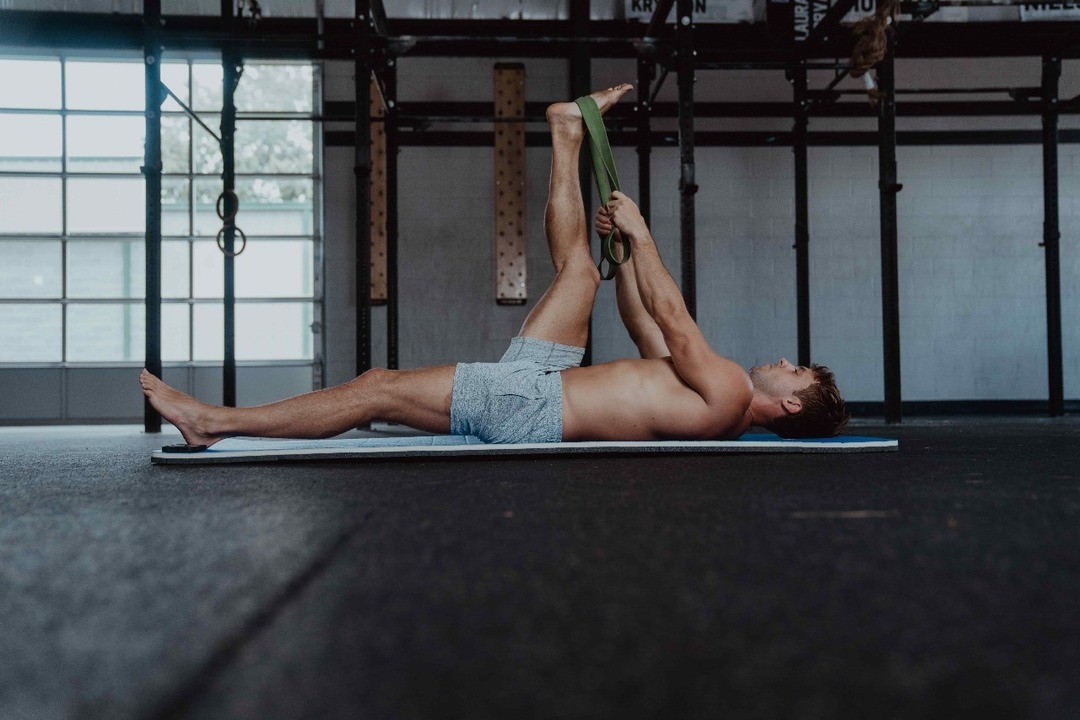
Hamstring stretches need to focus on the muscle without twisting your knee. Lie on your back with a resistance band looped around your foot, and straighten your leg toward the ceiling while keeping your other leg flat on the ground. This keeps your pelvis stable and prevents your lower back from compensating.
Hold for 30 seconds, and you should feel the pull along the back of your thigh, not behind your knee. If you feel sharp pain in the back of your knee, you're stretching too hard, or your knee is bending backward excessively. Lower the intensity until the sensation stays in the main muscle.
Why do calf stretches target two different muscles
Calf stretches work on both the gastrocnemius (the larger, visible calf muscle) and the soleus (the deeper muscle beneath it). Stand on a step with your heels hanging off the edge, then lower them below the step level until you feel tension. This stretches the gastrocnemius.
To reach the soleus, perform the same movement with your knees slightly bent. The soleus crosses your ankle but not your knee. When it tightens, it alters your walking pattern and increases stress on your back and knees.
How do quadriceps stretches affect the kneecap tracking
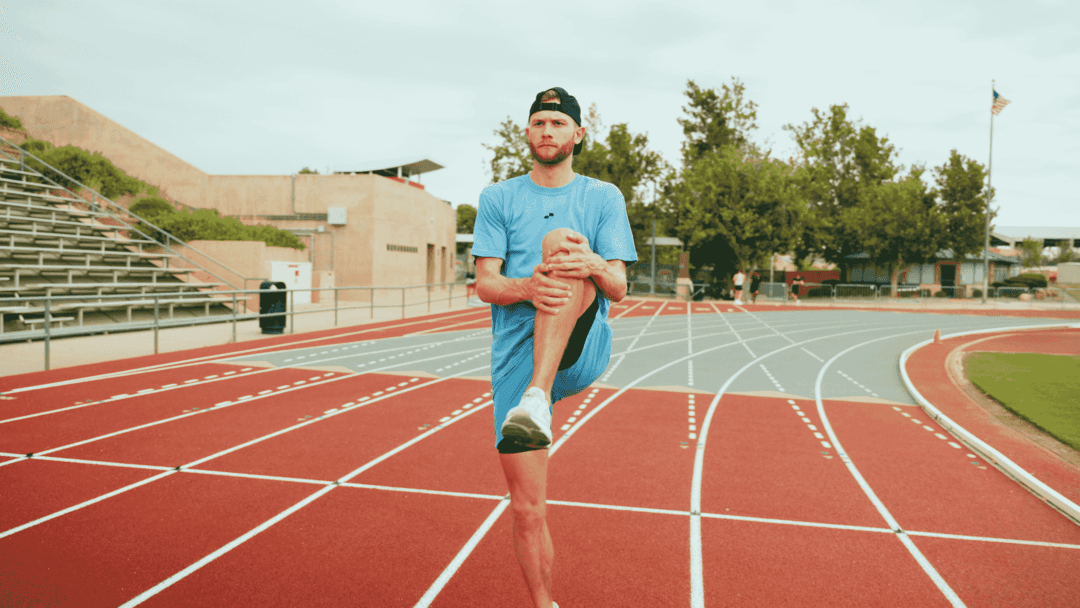
Quadriceps stretches balance front-to-back tension around your knee. Standing on one leg, pull your opposite heel toward your glutes while keeping your knees close together.
Tight quads pull your kneecap upward, altering its tracking through the femoral groove. This misalignment creates uneven pressure distribution across your knee joint, pushing excess synovial fluid toward the back of your knee.
What do knee flexion drills reveal about joint health
Knee flexion and extension drills restore the joint's ability to move smoothly through its full range of motion. Sit in a chair, slowly straighten your leg until it is parallel to the floor, hold for two seconds, then bend it back to 90 degrees. Repeat 15 times.
This pumps synovial fluid through the joint, nourishes cartilage, and helps determine whether you have a mechanical block (like a meniscus fragment catching) or muscular restriction limiting your range.
How do glutes control knee stability and alignment?
Your glutes control hip stability and knee alignment. When your glute medius (the muscle on the side of your hip) is weak, your femur rotates inward during single-leg activities like walking, running, or climbing stairs. This inward rotation forces your knee to collapse toward your midline, creating stress that strains the structures on the inside and back of your knee. Clamshells, side-lying leg lifts, and single-leg bridges activate the glute medius without requiring heavy loads or complex equipment.
Why must hamstring strengthening address multiple positions?
Hamstring strengthening must work the muscles in different positions because the hamstring group functions differently when your hip is bent versus straight. Bridges (lying on your back with knees bent, lifting your hips toward the ceiling) work the hamstrings with your hip straight. Nordic curls (kneeling with your ankles anchored, lowering your torso toward the ground while keeping your hips straight) create eccentric loading that builds strength against the rapid lengthening forces that cause strains during sprinting or jumping.
How should quadriceps strengthening emphasize control over load?
Quadriceps strengthening should prioritise control through the full range of motion rather than lifting the heaviest weight possible. Terminal knee extensions (standing with a resistance band looped behind your knee, straightening your leg fully against the band's resistance) strengthen the final 15 degrees of knee extension. This range is critical for walking stability and stair descent, yet it's the part most people lose first when pain develops.
What makes strengthening programs effective over time?
According to research involving nearly 10,000 patients examining non-drug treatments, strengthening programs work through consistent effort and gradual progression over weeks, not intensity in a single session. If you do 10 repetitions today and 10 next week with the same resistance, you maintain current strength but don't build new strength. Add one repetition each session, or increase resistance by small increments every 5 to 7 days.
When hamstring tightness persists and movement patterns remain unchanged, posterior knee pain returns immediately upon resuming activity. Platforms like Pliability provide guided video routines targeting specific muscle groups (hamstrings, calves, hip flexors) that contribute to posterior knee tension, offering personalized mobility sequences based on a three-minute assessment that identifies individual restrictions rather than prescribing generic stretches.
When should you seek professional evaluation for persistent knee pain?
If your pain persists beyond two weeks despite stretching and strengthening, or if you experience swelling, instability (your knee feels like it might give out), or locking (your knee gets stuck and won't fully straighten or bend), consult a physical therapist or doctor. These symptoms suggest structural damage (meniscus tear, ligament strain, or significant cartilage loss) that won't resolve with exercise alone. A physical therapist can perform specific tests to identify which structure is injured and create a rehabilitation program that protects the damaged tissue while restoring function to surrounding areas.
What does persistent swelling indicate about your knee condition?
Persistent swelling indicates ongoing inflammation inside the joint. Normal exercise soreness resolves within 24 to 48 hours, but persistent or worsening swelling suggests excess synovial fluid production due to irritation. Possible causes include a Baker's cyst, early osteoarthritis, or a meniscus tear, scraping cartilage surfaces with each step. Imaging tests, such as X-rays or MRI, can identify the underlying cause. Treatment options include aspiration, corticosteroid injection to reduce inflammation, or surgery to repair a tear if it causes mechanical symptoms.
How does knee instability differ from weakness?
Instability differs from weakness. Weakness means you struggle to generate force (like difficulty standing from a chair); instability means your knee unexpectedly shifts or buckles during normal activities. This suggests ligament damage (PCL or lateral collateral ligament strain) that has reduced your joint's ability to resist rotational or backward forces. Physical therapy focuses on neuromuscular control exercises that retrain the muscles around your knee to fire quickly enough to compensate for the damaged ligament's reduced support.
How do you measure improvements in range of motion?
Measure your range of motion weekly using a smartphone app or goniometer. Lie on your back, straighten your leg toward the ceiling without bending your knee, and measure the angle between your leg and the floor. If your hamstring flexibility improves, the angle will increase. If the number remains unchanged after two weeks of daily stretching, adjust your technique or investigate whether the restriction is due to a non-muscular issue.
How do you track pain levels during activities?
Rate your pain on a 0-10 scale during specific activities (walking, climbing stairs, squatting) and track it weekly. If your pain during stair descent was a 6 two weeks ago and is now a 4, that's measurable progress. If the number hasn't changed or has increased, your exercises aren't targeting the correct structures, or the volume exceeds your tissue's capacity to recover.
What functional improvements should you monitor?
Getting better at what your body can do matters more than how exercises feel. Can you squat deeper without pain? Walk farther before stiffness sets in? Kneel without sharp pain in the back of your knee? These abilities directly affect your quality of life and indicate whether your knee is strengthening.
Knowing the right exercises doesn't help if you can't identify which muscles should be working during each movement.
Related Reading
Stretches For Lower Back Stiffness
How To Reduce Stiffness After an Ankle Sprain
How To Relieve Morning Back Stiffness
Hip Stiffness Exercises
Muscle Stiffness Treatment
Left Arm Stiffness
How To Get Rid Of Neck Stiffness
Finger Stiffness And Locking Treatment
Best Supplements For Muscle Pain And Stiffness
Hand Stiffness Exercises
Improve Knee Mobility and Reduce Pain with Pliability Today | Get 7 Days Free
Stiffness behind your knee doesn't have to limit how you move or what you can do. Pliability offers guided video routines designed to reduce posterior knee pain, improve flexibility, and restore range of motion through exercises targeting the specific muscle groups causing your symptoms. The platform adapts to your current mobility level and builds progressively, providing a structured path forward.
💡 Tip: The body scanning feature identifies exactly where tightness or restriction exists behind your knee, so you're not wasting time on generic routines.
Daily programs adjust to your needs, whether you're dealing with tight hamstrings, calf restrictions, or compensatory patterns from hip instability. The exercises speed up recovery by building the mobility and stability your knee joint needs to function without pain. People see improvement when they address the root cause rather than the symptoms.
"Lasting results come from consistent, targeted work addressing the root cause of knee mobility issues." — Pliability Expert Guidelines
🎯 Key Point: Sign up today and get 7 days completely free on iPhone, iPad, Android, or web.
Regain confidence in your mobility with routines built by experts who understand that lasting results come from consistent, targeted work addressing the root cause. The platform's progressive approach ensures you're building sustainable mobility rather than temporary relief.




Move better in 10 minutes a day.
10,000+ five-star reviews.