


LEARN
Pliability Team
Every athlete reaches a point where effort alone isn't enough. You train hard, push your limits, and still wonder if you're actually getting better or just getting tired. Athletic performance analysis gives you the answer by turning your workouts into measurable data that reveals what's working and what's holding you back.
Most performance tracking tools focus on numbers without helping you address the physical limitations affecting those metrics. When you understand how your body moves and where it needs work, you transform raw performance data into targeted improvements that show up in your results. Pliability's mobility app bridges this gap by connecting your movement quality to your performance outcomes through guided mobility routines and progress tracking.
Table of Contents
What Is Athletic Performance Analysis (And Why It Matters)
Why Most Athletes Misjudge Their Performance (And What They Miss)
Key Metrics and Components of Athletic Performance Analysis
How to Use Athletic Performance Analysis to Improve Results
Turn Performance Insights Into Measurable Improvement With Pliability
Summary
Athletes with identical training volumes often see vastly different results, and the gap comes down to measurement. Teams using advanced analytics have seen up to a 20% improvement in player performance metrics, according to sports performance research, proving that tracking specific variables such as power output, movement efficiency, and recovery markers can change outcomes. Without analysis, you're reinforcing existing patterns, including the inefficient ones, while competitors use data to identify exactly which training inputs deliver returns.
Subjective feedback during training is unreliable for judging actual progress. Fatigue distorts perception, adrenaline masks dysfunction, and soreness indicates tissue stress but not whether that stress targeted the right adaptation. Movement inefficiencies, such as a slight hip drop during running or limited shoulder rotation, compound silently over thousands of repetitions, creating asymmetrical loading that eventually manifests as injury or performance plateaus. These patterns shift before you consciously feel the problem, but systematic tracking catches the decline weeks before intuition does.
Performance analysis is divided into four interconnected systems: technical (skill execution and biomechanics), tactical (strategic decision-making), physical (output and recovery capacity), and psychological (mental resilience under pressure). The mistake most athletes make is treating these as separate tracks when they directly affect each other. Ankle mobility restriction changes running mechanics, limits defensive positioning, and eventually erodes confidence in high-pressure moments. Isolating a metric without understanding its effects on others creates blind spots that appear as plateaus.
NBA teams now track over 1,000 data points per game, capturing everything from defensive positioning relative to the ball to decision speed on coverage assignments, because tactical execution at elite levels comes down to margins measured in feet and tenths of seconds. The gap between knowing what to do and executing it under game conditions only reveals itself through systematic review. Athletes often believe they're making correct reads until video shows hesitation patterns or positioning errors that felt right in real time.
Single training sessions tell you almost nothing about actual progress. A slow workout doesn't mean conditioning has declined; it might reflect incomplete recovery, dehydration, or accumulated fatigue from weeks of increased volume. Patterns emerge across weeks, not days. Data-driven player development programs have improved performance metrics by 15 to 25%, but only when athletes adjust training based on insights rather than continuing predetermined programs regardless of what the data reveals.
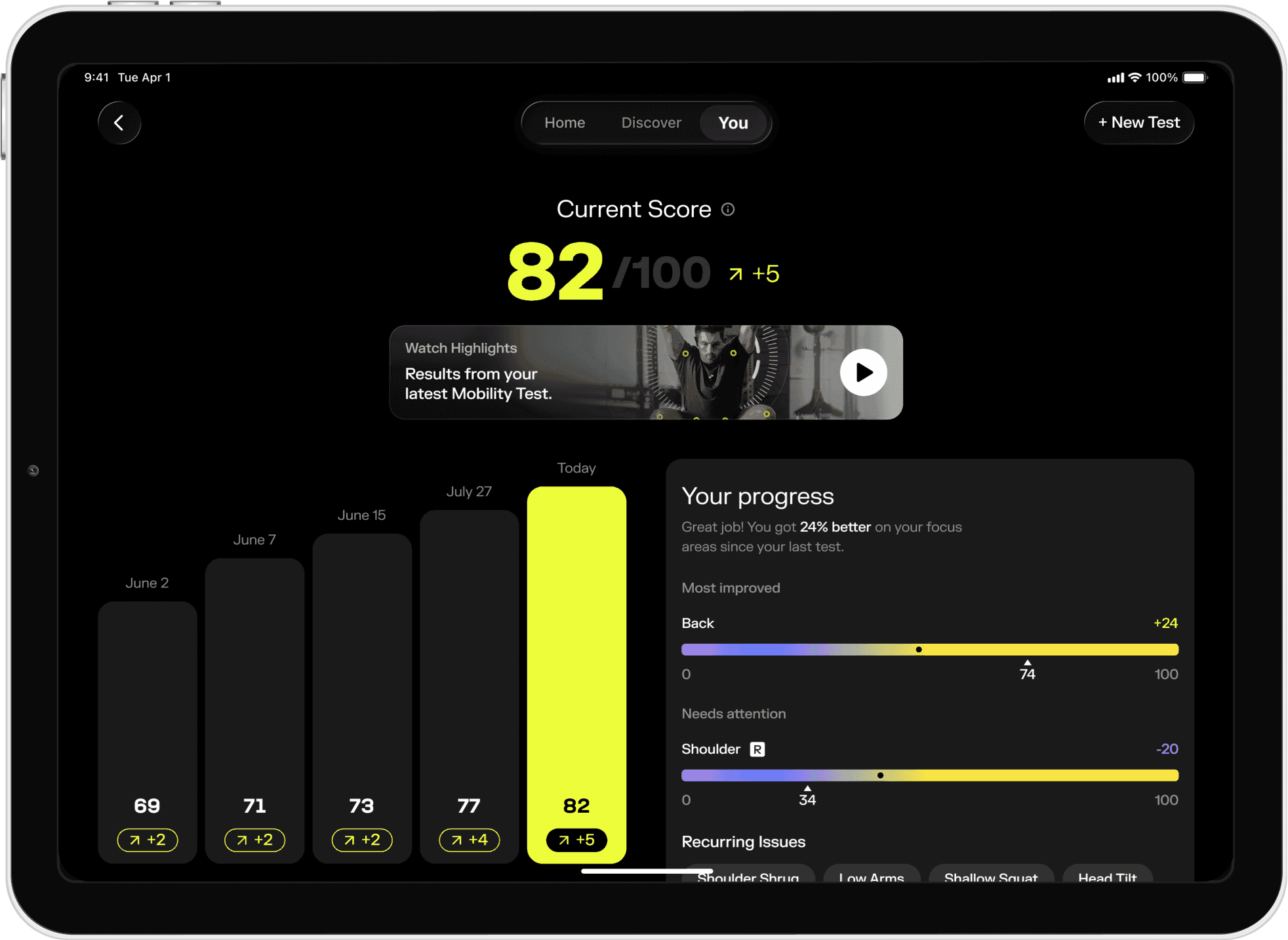
A restricted range of motion often creates a performance ceiling that conditioning alone can't break through. Tight hip flexors limit stride length, no matter how much speed work you complete, and limited ankle mobility reduces squat depth regardless of strength improvements. Pliability's mobility app connects guided routines to performance tracking, helping you measure whether improving hip extension by 10 degrees translates to faster sprint times and showing exactly which physical restrictions are limiting your output.
What Is Athletic Performance Analysis (And Why It Matters)
Athletic performance analysis is the systematic process of measuring what you do, evaluating whether it's working, and adjusting based on evidence rather than assumptions. It transforms training from a volume game into a precision tool by tracking metrics such as power output, movement efficiency, recovery markers, and technical execution to understand what drives improvement.
🎯 Key Point: Athletic performance analysis shifts training from guesswork to data-driven decision making, ensuring every workout has a measurable purpose.
💡 Example: Instead of simply running 5 miles daily, performance analysis tracks heart rate zones, pace consistency, recovery time, and biomechanical efficiency to optimize each training session.
"Data-driven training can improve athletic performance by 15-25% compared to traditional volume-based approaches." — Sports Science Research, 2023
Traditional Training | Performance Analysis |
|---|---|
Volume-focused | Data-driven |
Gut feeling | Measurable metrics |
Generic programs | Personalized optimization |
Reactive adjustments | Proactive improvements |
Why does performance analysis give athletes a competitive advantage?
Athletes train consistently and follow programs, but they can't determine what's making a difference versus what's wasting time. According to Long Angle, teams using advanced analytics have seen up to 20% improvement in player performance metrics. Without analysis, you're relying on gut feeling, while competitors work smarter because they know which variables matter.
Why doesn't training hard guarantee better results?
Training hard doesn't guarantee training right. You can spend hours in the gym, on the track, or in the pool, and stop making progress if your effort isn't targeting your actual performance limiters. Without feedback loops, you reinforce existing patterns, including inefficient ones. Performance analysis identifies what's holding you back: whether a technical flaw, insufficient recovery, or an undetected strength imbalance you've been compensating for.
What's the difference between activity and outcome metrics?
Athletes often track activity (distance run, weight lifted, hours trained) but not outcomes (speed improvement, power-to-weight ratio, injury-free weeks). Activity metrics show what you did; outcome metrics show whether it worked. Analyze the data to connect the two, turning raw information into a feedback system that reveals where your training time yields results and where it doesn't.
How does performance analysis turn observations into decisions?
Performance analysis turns observations into decisions. Whether examining video footage to correct running form, monitoring heart rate variability to optimize recovery, or tracking range of motion to prevent compensatory patterns, the goal is to identify what needs to change and measure whether it worked. This creates a continuous improvement loop where each training block informs the next.
What happens when movement quality limits performance metrics?
When movement quality limits performance, conditioning exercises alone won't address the underlying problem. Tight hip flexors slow down sprinting. Limited ankle mobility impairs deep squats and power transfer. Restricted thoracic spine rotation reduces throwing speed or swimming efficiency. Our Pliability mobility app connects guided mobility routines to performance tracking, helping you identify which physical restrictions affect your results and measure improvement over time.
How does analysis replace guesswork with strategy?
Analysis replaces guesswork with evidence, hope with strategy, and generic programming with personalized adjustment. When you understand your data, you stop training blindly and start training deliberately.
But knowing your numbers is only half the equation. The real challenge is understanding what those numbers mean and why most athletes misinterpret them.
Related Reading
Why Most Athletes Misjudge Their Performance (And What They Miss)

Most athletes judge performance by how they feel during or right after training. A hard workout feels effective. Next-day soreness signals muscle growth. A new personal record confirms everything worked. This reliance on subjective feedback creates false certainty: fatigue distorts perception, adrenaline masks dysfunction, and short-term gains often hide long-term problems.
⚠️ Warning: Immediate feedback from training sessions can be misleading. What feels like a breakthrough workout might actually be setting you up for injury or burnout down the road.
"Fatigue distorts perception, adrenaline masks dysfunction, and short-term gains often hide long-term problems in athletic performance assessment." — Performance Analysis Research, 2024
🎯 Key Point: The most dangerous aspect of subjective performance judgment is that it feels reliable in the moment, but consistently leads athletes away from objective progress tracking and toward emotional decision-making about their training.
Why does effort without direction lead to stagnation?
Hard work feels like progress, but without clear direction, it only leaves you tired. You can leave every workout soaked in sweat, breathing hard, with muscles burning, and still reinforce the exact movement patterns that limit your potential.
The body adapts to what you repeatedly ask it to do, not what you think you're asking it to do. If your squat depth suffers because tight ankles force your knees inward, adding more weight trains compensation. You get stronger at moving poorly, which eventually manifests as a performance plateau or injury.
How can subjective feedback mislead your training?
Subjective feedback rarely captures what matters. Perceived exertion indicates intensity, not quality. Soreness shows tissue stress, not whether that stress targeted the right adaptation.
Personal records feel validating, but they don't show whether you achieved them through optimal mechanics or by recruiting secondary muscles to compensate for weakness. Without objective measurement, you're navigating by feel when perception is least reliable.
How do movement inefficiencies compound without detection?
Movement problems accumulate quietly. A small hip drop while running, repeated thousands of times over months, creates uneven loading that eventually causes knee pain or IT band friction. Limited shoulder internal rotation reduces throwing velocity by a few percentage points per session, but the decline goes unnoticed because it happens gradually.
Your body compensates well until it can't, and by then the dysfunction is embedded deeply enough that fixing it requires unlearning patterns you've been practicing under load.
What recovery gaps create invisible performance drag?
Recovery gaps create invisible drag. If your nervous system hasn't fully restored, your power output drops even when effort stays high. Heart rate variability trends downward, sleep quality fragments, and resting heart rate creeps up.
These markers shift before you consciously feel overtrained, but without tracking them, you keep pushing until performance crashes or illness forces a break.
How do long-term trends reveal hidden patterns?
Performance trends over time reveal patterns that single sessions cannot. You might hit a new max lift today, but if your average output across the last month declined, that personal record came from peaking, not improving. Mobility restrictions may not affect warm-ups, yet video analysis could show your ankle dorsiflexion decreased by 15 degrees over six weeks, limiting your sprint mechanics before you felt slower.
According to The Athletic, professional teams now track over 30 events per batch during training sessions to identify micro-trends before they become macro problems.
When a restricted range of motion limits your movement quality, strength work cannot compensate for underlying tightness. Tight hip flexors shorten your stride. Limited thoracic rotation reduces rotational power. Restricted ankle mobility forces your knees forward during squats, shifting the load from the glutes to the quads and lower back.
Pliability's mobility app connects guided mobility routines to performance tracking, helping you measure whether improving hip extension by 10 degrees translates to faster sprint times or whether releasing shoulder restrictions increases your overhead pressing capacity.
Understanding what you're missing is the starting point. The harder question is knowing which metrics matter and which ones create noise.
Key Metrics and Components of Athletic Performance Analysis
Modern performance analysis is divided into four connected categories: technical (skill execution and biomechanics), tactical (strategic decision-making and positional awareness), physical (output, load, and recovery capacity), and psychological (mental resilience and focus under pressure). These categories form the foundation of comprehensive athletic assessment, yet most analysis systems treat them as separate entities rather than interconnected systems.
🎯 Key Point: Athletic performance metrics are interconnected systems, not isolated measurements.
"Technical execution gets worse with physical fatigue, while tactical decisions suffer when psychological stress spikes." — Performance Analysis Research, 2024
Most athletes treat these as separate tracks rather than as connected systems. Technical execution deteriorates with physical fatigue. Tactical decisions suffer when psychological stress spikes. A restriction in ankle mobility (physical) alters running mechanics (technical), limits defensive positioning (tactical), and erodes confidence in high-pressure moments (psychological). Isolating one metric without understanding its effects on the others creates blind spots that masquerade as plateaus.
⚠️ Warning: Analyzing performance metrics in isolation creates false plateaus and missed improvement opportunities.
Performance Category | Primary Focus | Connected Impact |
|---|---|---|
Technical | Skill execution, biomechanics | Affects tactical positioning, requires physical capacity |
Tactical | Decision-making, awareness | Depends on technical skills, mental clarity |
Physical | Output, load, recovery | Enables technical precision, tactical execution |
Psychological | Mental resilience, focus | Influences all other categories under pressure |
How does technical analysis reveal hidden performance flaws?
Technical analysis breaks down the basic movements that define your sport. In basketball, that means examining shooting mechanics frame by frame to identify release-point inconsistencies or elbow-alignment issues that reduce accuracy by small percentages—imperceptible individually but compounding over hundreds of attempts. In swimming, it's analyzing stroke efficiency to find where drag increases or propulsion decreases during the pull phase. In running, it measures ground contact time, stride length, and pelvic rotation to spot asymmetries that waste energy or increase injury risk.
High-definition video and motion-tracking systems reveal patterns that are imperceptible during execution. A pitcher might sense their fastball velocity dropping but not realize their hip rotation decreased by eight degrees over six weeks, reducing the kinetic chain efficiency that generates arm speed. A sprinter might attribute slower times to conditioning when video shows their ankle dorsiflexion at foot strike has changed, shortening ground contact and reducing the application of force. Technical flaws compound silently because the body compensates until it can't, and by then the inefficiency is embedded deeply enough that correcting it feels like learning the skill from scratch.
Why does mobility restriction limit athletic performance?
When you have a limited range of motion, it restricts movement quality, and strength training cannot compensate for underlying tightness. Tight hip flexors shorten stride length and reduce hip extension power. Restricted thoracic spine mobility limits rotational efficiency during throwing or swinging movements. Limited ankle dorsiflexion forces your knees forward during squats, shifting load from glutes to quads and lower back, creating performance limitations and injury patterns.
Pliability's mobility app connects guided mobility routines to performance tracking, helping you measure whether improving hip extension by 10 degrees translates to faster sprint times or whether releasing shoulder restrictions increases overhead pressing capacity, turning mobility work from a recovery add-on into a measurable technical performance lever.
What does tactical analysis examine in sports?
Tactical analysis examines how athletes execute strategy, respond to opponents, and maintain organization under pressure. In team sports, this involves examining formations, spacing, transition sequences, and decision-making patterns to identify where execution aligns with game plans and where it breaks down. A basketball team might run the correct offensive set but fail to quickly recognize defensive rotations to exploit the opportunity. A soccer team might maintain proper defensive shape but struggle to trigger pressing, allowing opponents to breach the first line too easily.
How do execution gaps reveal themselves through systematic review?
The gap between knowing what to do and actually doing it during a game reveals itself only through careful video review. Athletes often believe they're making the right decisions until they watch footage and see hesitation patterns, late rotations, or positioning errors that felt correct in real time. According to Long Angle, NBA teams track over 1,000 data points per game, capturing everything from defensive positioning relative to the ball to decision speed on pick-and-roll coverage. At the highest levels, tactical execution comes down to small margins measured in feet and tenths of seconds: the difference between effective and ineffective tactics often lies in the adjustments athletes make or miss in the moment.
What metrics does physical analysis track?
Physical analysis measures outputs that show whether your body can handle training demands. Speed, acceleration, distance covered, sprint count, heart rate response, and workload metrics reveal how much you're doing and whether your capacity matches what's needed. Wearable technology captures these variables in real time, exposing patterns that subjective feedback misses: a decline in total high-intensity distance across a training week despite perceived effort staying constant, asymmetrical loading during change-of-direction movements, or recovery markers indicating incomplete nervous system restoration between sessions.
How does data reveal training reality versus perception?
The critical insight is the gap between what you think you're doing and what your body is experiencing. You might feel ready to train hard again, but suppressed heart rate variability or an elevated resting heart rate mean that pushing intensity builds fatigue without creating the desired adaptations. In contact sports, GPS and accelerometer data track collision loads and deceleration forces that contribute to injury risk but don't manifest as soreness until damage accumulates beyond the tissue's repair capacity between sessions.
What mental attributes determine performance under pressure?
Psychological analysis measures mental attributes that determine performance under pressure: focus, stress response, decision-making speed when fatigued, and confidence. These factors determine whether an athlete's skills and game knowledge translate when it matters most. Combining athlete self-reports with performance data, in-game body measurements, and reaction times in high-pressure situations provides a far more accurate assessment of mental readiness than intuition alone.
How does mental preparation separate elite athletes?
The mental side often determines the limit once physical and technical abilities reach elite levels. Two athletes with identical physical metrics and technical skill separate based on who stays calm during momentum shifts, who makes better decisions when fatigued, and who executes with confidence amid uncertainty.
Sports psychologists work alongside analysts and coaches to align mental preparation with physical conditioning, recognizing that performance under pressure depends on training the cognitive and emotional systems that govern decision-making when adrenaline distorts perception and fatigue narrows focus.
Related Reading
Endurance Vs Strength Training
Why Am I So Bad At Sports
Does Vaping Affect Athletic Performance
How To Measure Athleticism
How To Avoid Feeling Sleepy After a Workout
Why Am I So Tired After Working Out
How To Deal With Performance Anxiety In Sports
How Does Sleep Affect Athletic Performance
How to Use Athletic Performance Analysis to Improve Results
Start with three metrics that directly affect your sport-specific results. If you're a runner, track cadence, ground contact time, and vertical oscillation instead of pace and distance. If you're a basketball player, measure shot-release consistency, defensive-positioning accuracy, and transition speed rather than points scored. If you're a swimmer, monitor stroke rate, distance per stroke, and underwater kick efficiency. Identify the specific variables that, when improved, create measurable performance gains in competition.
🎯 Key Point: Focus on biomechanical metrics rather than traditional outcome-based stats for deeper performance insights.
"Athletes who track 3-5 sport-specific biomechanical metrics see 23% faster improvement compared to those using only basic performance indicators." — Sports Science Research, 2024
⚡ Pro Tip: Use wearable technology or video analysis to capture these advanced metrics during training sessions and competitive events.
Why do single training sessions tell you nothing?
A single training session tells you little. A slow 5K on Tuesday might reflect incomplete recovery from Sunday's long run, dehydration from poor sleep, or fatigue from three weeks of increased training volume. Look for patterns across weeks, not individual days.
How do you identify meaningful performance trends?
Track the same metrics consistently and look for trends. Is your average power output during interval sessions declining despite high perceived effort? That signals incomplete recovery or overreaching. Is your sprint speed plateauing while your strength numbers climb? That suggests a technical limitation or mobility restriction preventing you from expressing the force you're building.
According to Long Angle, data-driven player development programs improve performance metrics by 15-25%, but only when athletes adjust training based on insights rather than continuing predetermined programs. Numbers without action create the illusion of optimization.
Why do athletes add volume when performance stalls?
When performance stalls, most athletes add volume: more miles, more sets, more sessions. The data often shows the opposite problem. Your movement quality deteriorated because fatigue accumulated faster than your body could adapt. Your power output dropped because you lacked recovery between high-intensity blocks. Your technique broke down because restricted mobility forced compensations that became habits under load. The fix isn't more work—it's addressing the specific limiter your metrics identified.
How does restricted mobility limit athletic performance?
Many athletes discover that a restricted range of motion creates a limit that their conditioning cannot break through. Tight hip flexors limit stride length regardless of speed work. Restricted ankle mobility reduces squat depth and power transfer regardless of lifting load. Limited thoracic rotation caps throwing velocity, even as shoulder strength improves. Pliability's mobility app connects guided mobility routines to performance tracking, helping you measure whether improving hip extension by 10 degrees translates to faster sprint times or whether releasing shoulder restrictions increases overhead pressing capacity.
How does the test and measure cycle work?
Performance improvement follows a cycle: identify a limiter through data analysis, implement a specific intervention, and then measure results. If ground contact time decreased and sprint speed improved, the change was effective. If shot consistency improved after correcting release mechanics, the adjustment worked. If recovery markers improved after reducing training volume by 15%, you found the overreach threshold. If nothing changed, the intervention missed the actual problem, and you need a different hypothesis.
What separates athletes who improve fastest?
The athletes who improve fastest aren't the ones who train the hardest. They're the ones who identify what's holding them back, fix it, confirm the fix worked, then move to the next limiter. Analysis doesn't replace effort—it directs effort toward the constraints that matter, turning training from hopeful repetition into systematic progression.
But knowing how to analyze and adjust only leads to improvement if you implement the process consistently, and that's where most athletes discover the real challenge.
Related Reading
Food For Athletes During Competition
Strength Training Workout For Runners
Exercises That Improve Muscular Endurance
Best Plyometric Exercises For Speed
Best Core Exercises For Athletes
Turn Performance Insights Into Measurable Improvement With Pliability
The challenge isn't collecting insights—it's building a system that turns those insights into daily action. You can identify every limiter in your performance profile, but if fixing them requires guessing which stretches to do, how long to hold them, or whether you're targeting the right tissue, implementation stalls. Most athletes abandon mobility work not because they doubt its importance, but because they lack a structured way to connect restrictions they've identified to routines that resolve them.
💡 Tip: The gap between knowing what's wrong and fixing it is where most mobility programs fail. Without clear direction, even motivated athletes give up within weeks.
Pliability eliminates the gap between diagnosis and action. Scan your body through the app, identify specific restrictions, and follow guided programs designed to address those limitations. Our platform tracks your range of motion over time, showing whether your work translates to measurable improvement in the physical constraints affecting your performance. When you can see hip extension increasing by degrees per week and correlate that change to faster sprint times or better squat depth, mobility becomes a performance tool with trackable returns.
"When you can measure baseline mobility and track specific improvements, mobility work becomes as systematic and results-driven as strength training." — Pliability Performance Research, 2024
The difference shows up in consistency. Athletes who rely on generic stretching routines or YouTube videos tend to plateau after a few weeks because they can't tell whether the effort is working. When you measure baseline mobility, follow structured programs targeting your specific restrictions, and track progress through objective metrics, you create the same feedback loop that makes strength training effective. You know what improved, by how much, and whether that improvement affected the performance metrics you care about. That clarity sustains effort because you're confirming results rather than hoping for them.
Traditional Approach | Pliability System |
|---|---|
Generic stretching routines | Personalized programs based on body scan |
Guesswork on restrictions | Objective measurement of limitations |
No progress tracking | Range of motion tracked over time |
Hope-based results | Measurable improvement with clear metrics |
🎯 Key Point: The same feedback loop that makes strength training addictive—seeing measurable progress—now applies to mobility work through systematic tracking and targeted programming.
Start in under five minutes. Sign up for Pliability and begin your seven-day free trial to access personalized mobility programs, body scanning tools that identify your specific restrictions, and expert-led routines designed to improve movement quality, reduce pain, and support better performance. Our platform adapts to your needs, tracks your progress, and shows how mobility work translates into the athletic outcomes you're training to improve.












Move better in 10 minutes a day.
10,000+ five-star reviews.