


LEARN
Pliability Team
Athletes who explode off starting lines or launch into gravity-defying vertical jumps demonstrate the power of ballistic training. This specialized method builds raw explosive power through exercises such as medicine ball throws, jump squats, and variations of Olympic lifts. Understanding the science behind ballistic movements allows athletes to transform their speed, force production, and sport-specific performance.
Building explosive power requires muscles and connective tissue that can withstand the intense forces generated during high-velocity movements. Joints and soft tissues must move through full ranges of motion while maintaining resilience against injury risk. When the body can properly handle the demands of explosive exercises, athletes generate more force and achieve better results from every training session with Pliability's mobility app.
Table of Contents
What Is Ballistic Training and Why Is It Important for Sport?
Ballistic vs. Plyometric: Understanding Dynamic Movements
10 Best Ballistics Training Movement Patterns for Athletes
How Do I Program Plyometrics & Ballistics?
Improve Mobility, Recover Faster, and Move More Explosively
Summary
Ballistic training eliminates the deceleration phase present in traditional strength work, allowing athletes to accelerate loads or their own body mass through complete ranges of motion without braking. Research shows that athletes spend roughly half of a standard bench press rep decelerating the bar, which directly contradicts the force-application patterns required in sport. This training method targets the 30 to 45 percent of the maximum strength range where force and velocity converge most effectively for power development.
Rate of force development separates athletes with identical strength levels but vastly different performance outcomes. Sport movements occur in 0.1 to 0.2 seconds, while maximum strength develops over 0.4 seconds or longer, creating a gap that traditional lifting cannot address. Two athletes with the same squat max can produce dramatically different vertical jumps because one generates force faster, demonstrating why ballistic training creates better transfer to explosive athletic actions than strength work alone.
Ballistic and plyometric training produce distinct physiological adaptations despite their apparent similarity. Ballistic movements emphasize concentric force production and neural drive, teaching the nervous system to recruit muscle fibers rapidly without inhibitory braking signals. Plyometric training exploits elastic energy storage in tendons and fascia through rapid stretch-shortening cycles, with one study showing 14.2 percent improvements in agility and 12.3 percent improvements in smash time.
Explosive training quality deteriorates rapidly under fatigue, making volume management critical for power development. Athletes new to ballistic and plyometric work should start with 80 to 100 ground contacts per week and progress toward 120 to 140 as adaptations occur, with 48 to 72 hours of recovery between intense sessions. Higher volume doesn't improve the rate of force development and instead creates redundant stress without additional benefit, particularly for athletes whose sports already involve repeated explosive actions.
Structured plyometric programs can produce 10 to 15 percent improvements in vertical jump height when progression is deliberate and fatigue is managed appropriately. Intensity should scale gradually from bilateral movements that distribute force across both legs to single-leg variations demanding more stability, with external load added only after movement quality remains consistent under bodyweight conditions. Rushing into high-intensity work before the body adapts leads to tendonitis rather than performance gains.
Pliability's mobility app provides guided sessions that restore range of motion and reduce tissue stiffness between explosive training sessions, helping athletes maintain the joint positions and movement capacity required for ballistic exercises.
What Is Ballistic Training and Why Is It Important for Sport?
Ballistic training involves speeding up a load or your own body through the complete range of motion without slowing down at the end. You throw a medicine ball as hard as possible or explode upward in a jump squat. The defining feature is the absence of a slowing-down phase.
🎯 Key Point: Unlike traditional weight training, where you decelerate at the end of each rep, ballistic movements maintain maximum acceleration throughout the entire motion, making them ideal for explosive power development.
💡 Example: Think of the difference between a controlled bench press (where you slow down before lockout) versus throwing a medicine ball off your chest - the ballistic movement allows you to express true explosive intent.
"Ballistic training allows athletes to train at velocities and power outputs that closely match sport-specific demands, bridging the gap between strength and speed." — Sports Science Research, 2023
Traditional Training | Ballistic Training |
|---|---|
Deceleration phase present | No deceleration phase |
Controlled tempo | Maximum acceleration |
Strength focus | Power and speed focus |
Lower velocity | High velocity movement |
How does ballistic training differ from traditional strength training?
Traditional strength training requires you to slow down at the end of every rep to control the weight. Ballistic movements eliminate this deceleration, allowing maximum speed from start to finish.
Why is ballistic training more effective than explosive lifting?
Many athletes confuse ballistic training with fast lifting or plyometrics, but the goal differs fundamentally. When you bench press at maximum speed, research shows you spend about half the movement decelerating the bar to prevent it from flying off your chest. This deceleration works against you when your sport demands rapid application of force. Ballistic training eliminates this constraint by removing the need to control the weight at the end. You let it go.
How does the force-velocity relationship affect athletic performance?
The force-velocity curve reveals a counterintuitive principle: force and velocity work against each other. Lift your one-rep max, and the bar moves slowly. Squat jump with an empty bar, and it shoots upward fast. According to Wikipedia's analysis of ballistic training, power develops best at 30-45% of maximum strength, the sweet spot where force and velocity converge.
Rate of force development separates good athletes from great ones. Two athletes with identical squat maxes can jump differently because one generates force faster. Sport movements occur in 0.1 to 0.2 seconds, while maximum strength develops force over 0.4 seconds or longer. This gap is where ballistic training makes a difference.
Why do ballistic exercises train the nervous system differently?
A sprinter exploding out of blocks, a basketball player elevating for a rebound, a boxer throwing a cross—all require the ability to apply force faster than traditional lifting trains.
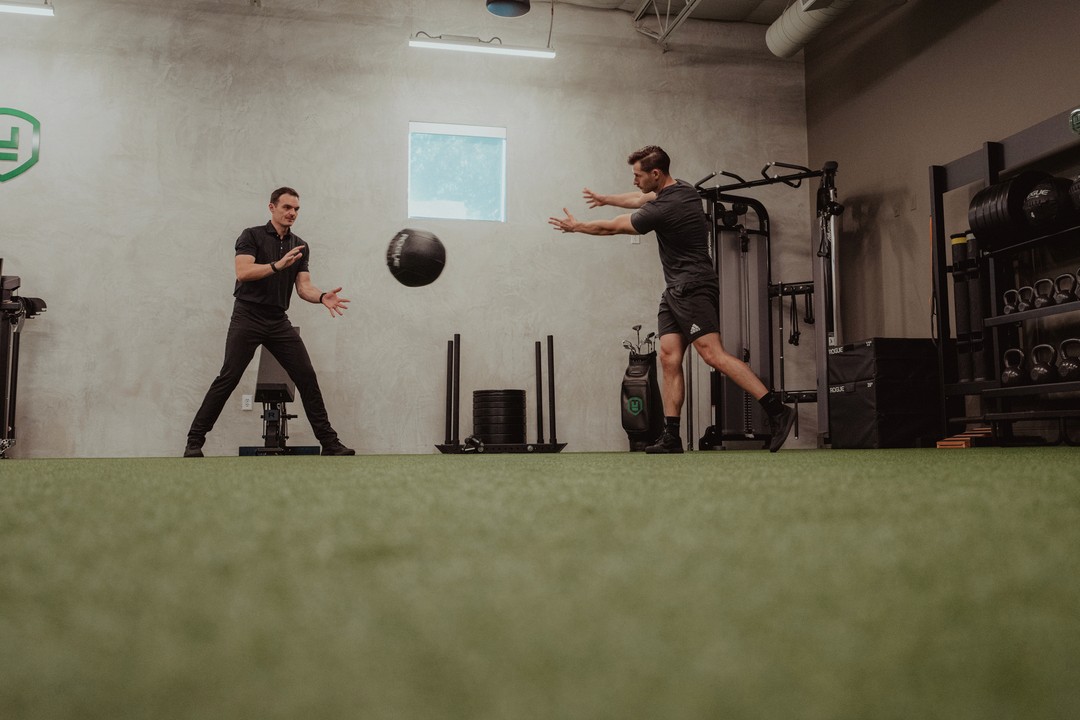
Medicine ball throws exemplify ballistic training for the upper body and core. You throw the ball with maximum intent, accelerating through the entire motion without worrying about catching or controlling it at release. The key insight is that ballistic exercises teach your nervous system to recruit muscle fibers at maximum speed without the learned deceleration patterns that traditional lifting reinforces.
How does mobility preparation support ballistic training?
Our Pliability mobility app delivers targeted routines that prepare your joints and connective tissues for the intense forces of ballistic training. Twelve-minute sessions focusing on hip mobility, shoulder range of motion, and thoracic rotation ensure your body handles maximum-velocity movements without compensating with restricted patterns. When soft tissues move freely through full ranges, you generate more force and absorb impact more efficiently.
But understanding ballistic training only scratches the surface. The real confusion starts when athletes try to distinguish it from nearly identical movements.
Related Reading
Deceleration Training
Force Absorption
Ballistic vs. Plyometric Understanding Dynamic Movements

Ballistic and plyometric training build explosive power in different ways. Ballistic movements focus on maximum speed through the entire range of motion, typically involving throwing or releasing something, such as medicine ball throws or jump squats. Plyometric movements use the stretch-shortening cycle, which means you load the muscle quickly while it's stretching, then immediately contract it, as in depth jumps or bounding. Confusing these two types of training can lead to programming mistakes that hinder performance gains.
Training Type | Key Mechanism | Example Exercises | Primary Focus |
|---|---|---|---|
Ballistic | Maximum speed through full ROM | Medicine ball throws, jump squats | Release/throwing movements |
Plyometric | Stretch-shortening cycle | Depth jumps, bounding | Load-then-contract pattern |
"The stretch-shortening cycle in plyometric training allows muscles to produce 20-30% more force compared to concentric-only contractions." — Journal of Sports Sciences
🎯 Key Point: Understanding the fundamental difference between ballistic speed focus and plyometric stretch-shortening helps you choose the right training method for your specific performance goals.
⚠️ Warning: Mixing ballistic and plyometric protocols without understanding their distinct mechanisms can lead to suboptimal programming and reduced explosive power development.
How does ballistic training differ mechanically from plyometric training?
Ballistic training focuses on concentric force production: speeding up a load or your body mass through full extension without slowing down. A medicine ball chest throw exemplifies this—you create maximum velocity through the pushing phase and release at peak acceleration. Your nervous system learns to produce force quickly without the inhibitory signals that normally slow movement at end range, developing strength-speed (the ability to move moderate loads explosively).
What makes plyometric elastic energy storage unique?
Plyometric training targets the storage and release of elastic energy. In a depth jump, you step off a box and absorb ground impact through rapid eccentric loading. Your tendons and fascia stretch like rubber bands, storing mechanical energy during the brief amortization phase (typically under 0.25 seconds), then explode upward, converting that stored energy into concentric force. According to the Journal of Medical & Health Sciences Review, plyometric training improved agility by 14.2% among badminton players, demonstrating that the transfer of elastic energy enhances reactive movements.
How does ballistic work improve muscle fiber recruitment?
Ballistic work increases how fast your muscles recruit fibers and how quickly your nervous system activates them. Your central nervous system learns to fire motor units simultaneously, enabling rapid force generation. This improves your ability to accelerate objects or your body from a stop or slow movement.
What changes occur in tendons and reflexes during plyometric training?
Plyometric training alters how your tendons function and your body's reflexes respond. Regular stretch-shortening cycles stiffen your tendons, allowing faster energy transfer between muscle contraction and joint movement. Stiffer tendons act like tighter springs, reducing the time lag between muscle activation and movement.
Your spinal reflexes adapt, shortening the delay between detecting a stretch and the contraction response. The Journal of Medical & Health Sciences Review reported a 12.3% improvement in smash times for the ballistic training group, indicating that concentric-focused training enhances projection speed in sport-specific movements.
What are specific examples of ballistic versus plyometric movements?
A box jump counts as ballistic: you dip into a countermovement, then explode upward with maximum intent. The eccentric phase happens slowly enough that the elastic contribution stays minimal. A depth jump counts as plyometric: you minimize ground contact time, bouncing off the surface before your muscles fully lengthen. Pogo jumps train pure elastic response. Push press throws with a barbell (releasing at the top) develop ballistic power. Clap push-ups train plyometric capacity.
How do you choose between ballistic and plyometric training?
Many athletes treat these movements as interchangeable, missing how each benefits the body in different ways. If you need to generate force from static positions or slower movements (like throwing or jumping from a standstill), ballistic work belongs in your program. If you need to improve directional changes, landing mechanics, or reactive strength (like cutting, bounding, or absorbing impact), plyometric training addresses those needs.
Tools like a mobility app help athletes maintain the tissue quality needed for both training styles by using expert-guided routines that preserve the range of motion and tendon health between explosive sessions. Understanding this difference matters only if you can execute these movements safely and effectively.
10 Best Ballistics Training Movement Patterns for Athletes
Ballistic exercises work only when they match the force demands, movement direction, and coordination capacity of the athlete. A power clean builds explosive strength through triple extension with a cushioned catch, while pogo hops develop ankle stiffness for rapid ground contact. The exercise matters less than understanding what adaptation it creates, which joints it loads, and whether your body can safely express that force pattern.
🎯 Key Point: The most effective ballistic training comes from exercise selection that directly matches your sport's movement demands and your current strength capacity.
"Ballistic exercises work only when they match the force demands, movement direction, and coordination capacity of the athlete." — Sports Performance Research
💡 Tip: Before adding any ballistic movement to your program, ask yourself: Does this exercise train the same force vector, joint angles, and timing patterns as your sport?
1. Power Clean (High Force Ballistic)
Stand with your feet shoulder-width apart, the bar over your shoelaces. Grip the bar outside your legs, keep your chin up, and look forward. Push through the floor to lift the bar, keeping it close to your body. Once the bar passes your knees, jump explosively to create upward momentum. Pull yourself under the bar and catch it in a quarter front squat.
Sport Transfer
Triple extension (ankle, knee, hip) mirrors the explosive pattern in sprinting, jumping, and directional changes, transferring vertical force production directly to acceleration out of a crouch or explosive first steps in field sports.
Force Direction
Primarily vertical, with emphasis on hip and knee extension power. The catch position requires front core stability and shoulder mobility to safely absorb load.
Athletic Adaptation
Builds the mid-to-high force part of the force-velocity curve by increasing neural drive and teaching the body to recruit muscle fibers quickly under load. The cushioned catch enables progressive overload beyond what jump variations allow.
Progression Logic
Master the front squat and deadlift hinge pattern first. Beginners start with hang cleans (bar at mid-thigh) to reduce coordination demands, then progress to full cleans from the floor as timing improves.
Caution
This is a technical movement. Adding weight before establishing the correct bar path, catch position, and timing risks shoulder and wrist injury. If your elbows drop or the bar falls onto your shoulders, reduce the weight and practice the mechanics of the pull-under.
2. Box Jump (High Velocity Ballistic)
Stand facing a plyo box 30 to 60cm high. Swing your arms back as you drop into a quarter squat, then reverse explosively, driving your arms upward as you jump onto the box. Land softly, heel-to-toe, absorbing impact through your legs. Step down slowly and reset.
Sport Transfer
Builds up-and-down jumping power without excessive stress on lengthening muscles, benefiting athletes seeking greater height or recovering from lower-body injury. Basketball, volleyball, and soccer players gain a significant advantage from the vertical force it creates.
Force Direction
Straight up, with hip and knee straightening as the main movers. The ankle does less work compared to depth jumps or pogo hops.
Athletic Adaptation
Trains how fast your muscles build force without the impact stress of jumping exercises. Increases muscular power during pushing movements and improves hip-knee coordination.
Progression Logic
Start with box heights that challenge your landing form without compromising it. Increase height by about 4 inches as you gain strength. Advanced athletes can add a weighted vest or pause at the bottom of the countermovement.
Caution
Box jumps don't build eccentric strength because the box absorbs landing forces. Athletes who train only with box jumps often struggle to slow down and change direction. Pair them with exercises that challenge landing mechanics (broad jumps, depth drops) to develop complete lower-body resilience.
3. Hand Release Push-Up (High Force Ballistic)
Lie face down with your hands by your sides in a push-up position. Tighten your core muscles. Push the floor away as hard and fast as you can so your hands leave the ground. Land with control, keeping your core tight and preventing your pelvis from dropping.
Sport Transfer
Builds upper-body pushing power for contact sports (rugby, football, MMA) where athletes must explosively extend through an opponent. It also transfers to gymnastics, climbing, and sports requiring rapid arm extension.
Force Direction
Horizontal pushing through the chest, shoulders, and triceps. Core strength prevents backward bending of the lower spine during flight.
Athletic Adaptation
Builds fast-twitch fiber recruitment in the chest and triceps while improving the stretch-shortening cycle in upper-body pushing patterns, making subsequent reps more explosive.
Progression Logic
Master standard push-ups with strict form (no sagging hips, full range of motion) before attempting ballistic variations. Beginners can start with hands on an elevated surface to reduce load, while advanced athletes progress to clap push-ups or plyometric push-ups on platforms.
Caution
You need baseline pushing strength before attempting ballistic upper-body work. If you can't perform 15 strict push-ups with controlled tempo, the eccentric landing phase will exceed your capacity and create shoulder or elbow strain.
4. Ball Slam (High Velocity Ballistic)
Raise a slam ball overhead with your arms fully extended. Throw it down at the floor with maximum force, engaging your core and lats. Catch the rebound or pick it up and reset.
Sport Transfer
Builds overhead pulling power for throwing athletes (baseball, javelin, handball) and combat sports requiring downward striking force. Benefits volleyball spikers and tennis servers.
Force Direction
Vertical (downward), driven by lat engagement, core flexion, and hip extension. Arm extension overhead loads the shoulders eccentrically during the deceleration phase.
Athletic Adaptation
Trains explosive trunk flexion and shoulder extension, patterns often neglected in traditional strength work.
Progression Logic
Start with lighter balls (4 to 6kg) to build movement quality and a full range of motion. Progress load only after demonstrating controlled deceleration overhead and aggressive acceleration downward. Advanced athletes can perform slams from a kneeling position to focus on upper-body power.
Caution
Ball slams place significant stress on the shoulder joint during the overhead eccentric phase. Athletes with limited shoulder mobility or rotator cuff weakness should address these gaps before adding ballistic overhead loading.
5. Trap Bar Jump (High Force Ballistic)
Step inside a trap bar and grip the handles. Tighten your core and jump with power, driving your head toward the ceiling instead of lifting your feet. Land with bent knees to absorb the impact through your legs.
Sport Transfer
Builds vertical power for sports requiring repeated jumping (basketball, volleyball) or explosive starts from a crouched position (sprinting, football). The neutral grip makes it accessible to athletes at any skill level.
Force Direction
Vertical, with balanced loading across hips, knees, and ankles. The trap bar's centered load reduces shear stress on the spine compared to barbell variations.
Athletic Adaptation
Targets the mid-range force-velocity curve, bridging heavy squats and unloaded plyometrics. Develops rate of force development without the coordination demands of Olympic lifts.
Progression Logic
Begin with bodyweight jumps to establish landing mechanics. Add 10-20kg initially, prioritizing jump height over load. Progress weight in small increments (5 to 10kg) as power output improves, but never at the expense of jump velocity.
Caution
The trap bar can strain the traps and upper back during the jump phase, limiting the weight you can lift compared to Olympic lifts with cushioned catch positions. If your shoulders rise excessively or you feel neck tension, reduce the weight and focus on driving through your hips.
6. Broad Jump (High Velocity Ballistic)
From a standing position, swing your arms back as you bend at the hips. Reverse the movement explosively, throwing your arms forward as you jump. Land heel-to-toe, absorbing the impact through your legs.
Sport Transfer
Horizontal power is important for accelerating, decelerating, and changing direction in field sports (soccer, rugby, lacrosse). The broad jump trains the force pattern athletes use during the first three steps of a sprint.
Force Direction
Horizontal, emphasizing hip extension and forward movement of the center of mass. Ankle plantar flexion aids propulsion, while knee extension stabilizes the landing.
Athletic Adaptation
Builds the ability to produce force side to side, a skill often neglected in programs focused on vertical jumping. It strengthens the front leg muscles (quads, hip flexors) and improves deceleration control.
Progression Logic
Begin with single broad jumps for maximum distance. Progress to repeated broad jumps (3 to 5 jumps in a row) to challenge the stretch-shortening cycle. Advanced athletes can add a weighted vest or perform broad jumps uphill for increased difficulty.
Why is horizontal force training often overlooked?
Many athletes think vertical power exercises cover all athletic needs, but horizontal acceleration requires applying horizontal force. A basketball player with a 36-inch vertical box jump might still struggle with first-step quickness without horizontal projection training. The broad jump builds the specific force direction that transfers to linear speed.
Tools like mobility app support ballistic training by maintaining hip flexor length and ankle mobility between sessions. Athletes performing repeated broad jumps often develop tightness in the hip flexors and calves due to explosive demands. Expert-guided routines preserve the range of motion required for full force expression.
7. Barbell Jump Squat (High Force Ballistic)
Take a barbell off the rack and rest it on your upper traps, as you would for a high-bar back squat. Stand with your normal squat stance. Lower yourself into a quarter squat, then push upward as hard as you can, jumping as high as possible. Focus on driving your head toward the ceiling rather than simply lifting your feet off the ground. Land with bent knees to absorb the weight.
Sport Transfer
Builds vertical power for sports requiring repeated jumping or explosive height changes (basketball, volleyball, skiing). The loaded jump squat also transfers to acceleration from a crouch in wrestling and football.
Force Direction
Vertical, with balanced contribution from hips, knees, and ankles. The barbell load increases demand on the back chain (glutes, hamstrings) compared to unloaded jumps.
Athletic Adaptation
Develops the mid-range force-velocity curve, increasing power output at moderate loads while teaching rapid muscle fiber recruitment under external resistance.
Progression Logic
Master bodyweight jump squats with consistent landing mechanics before adding load. Start with 20-30% of back squat max, prioritizing jump height and velocity. Progress load in 5kg increments only if the jump height remains consistent.
Caution
Barbell jump squats are less loadable than Olympic lifts because there's no cushioned catch position to absorb force. If the barbell bounces on your shoulders during landing or you feel compressive stress in your spine, reduce the weight immediately.
8. Depth Jump (High Velocity Ballistic)
Step off a plyo box (30-50cm high). When you hit the ground, immediately explode upward, jumping as high as you can. Minimize ground contact time while maximizing jump height.
Sport Transfer
Builds reactive strength for sports requiring quick force production after ground contact (sprinting, basketball, soccer). The stretch-shortening cycle trained in depth jumps transfers directly to cutting, bounding, and rebounding.
Force Direction
Vertical, with extreme eccentric loading during landing, followed by rapid concentric contraction. The ankle, knee, and hip all contribute to force absorption and production.
Athletic Adaptation
Trains the body to store and release elastic energy in tendons and fascia, increasing lower-body stiffness for faster force transmission and shorter ground contact times.
Progression Logic
Establish eccentric strength through tempo squats and controlled landings before attempting depth jumps. Start with low box heights (20 to 30 cm) and progress only if ground contact time decreases and jump height improves. Advanced athletes can increase box height or add directional changes after landing.
Caution
Depth jumps create the highest landing forces of any ballistic exercise, often exceeding 5 times bodyweight. Athletes without adequate eccentric capacity risk patellar tendon strain, ACL stress, or ankle injury. Do not attempt depth work unless you can land softly from a box jump and perform a controlled single-leg squat.
9. Snatch (High Force Ballistic)
Stand with your feet about shoulder-width apart, toes slightly outward (your strongest jumping stance). Position the bar over your shoelaces at hip height. Push the floor away to lift the bar, keeping it close to your body throughout. Once the bar passes your knees, jump as hard as you can, then pull your body under the elevated bar and catch it in an overhead squat position.
How does the snatch develop athletic power?
The snatch trains your entire force-velocity spectrum. The initial pull is high-force, low-velocity. The explosive hip extension past the knees is moderate-force, moderate-velocity. The turnover and catch require rapid force production and positional strength under load. For sport transfer, this movement improves triple extension (ankles, knees, hips): the foundation of jumping, sprinting, and throwing. It also develops overhead stability that transfers to sports that require overhead force, such as volleyball, tennis serves, and throwing sports.
The benefit is comprehensive power development: force production, rate of force development, coordination, mobility, and positional strength simultaneously. Olympic weightlifters consistently demonstrate some of the highest vertical jump scores across all athletes despite rarely practicing vertical jumps, because the snatch trains the same neuromuscular qualities through a different movement pattern.
What are the challenges and risks of snatching?
The drawback is technical complexity. The snatch requires ankle, hip, and thoracic mobility to achieve proper positions and demands precise timing between the pull, jump, and turnover. Most athletes need 6–12 months of consistent practice before loading meaningfully. Rounding your back in the starting position, cutting your pull short, or catching the bar forward of your midline reinforces poor movement patterns under load, increasing injury risk and limiting athletic transfer.
How should you progress with snatch training?
To get better at snatches, beginners should first learn the overhead squat position and hang snatch (starting from mid-thigh) before attempting full snatches from the floor. Intermediate athletes can use 40-60% of their back squat max once their technique is solid. Advanced athletes can work toward 70-85% of back squat max, though good technique must precede adding weight. If your catch position deteriorates or you're missing lifts forward, reduce weight and focus on positional strength and timing.
10. Pogo Hops (High Velocity Ballistic)
Stand tall with your hands on your hips. Start doing quick, continuous bounds off the balls of your feet with minimal knee bend, as if skipping with an invisible rope. Keep your ankle and calf stiff while spending minimal time on the ground. You're training your ankle complex to generate and absorb force quickly through a short range of motion, similar to the ground-contact phase of sprinting or distance running.
How do pogo hops improve running performance?
When you sprint, your ankle plantarflexors (calf muscles and Achilles tendon) create roughly 40% of the propulsive force during ground contact, which lasts only 0.08–0.12 seconds at top speed. Pogo hops train this exact skill: quick force production and absorption through the ankle with minimal knee and hip involvement. Distance runners benefit because improved ankle stiffness and reactive strength reduce energy expenditure, allowing you to maintain pace with less effort.
What are the benefits and limitations of pogo hops?
The benefit is targeted ankle and calf development without excessive loading on the knees and hips. Many athletes who struggle with knee pain during jumping exercises can tolerate pogo hops because the movement emphasizes ankle stiffness rather than deep knee flexion. You build the capacity to develop and absorb force in short ground contact times, which forms the foundation of efficient running mechanics.
The drawback is limited transfer to athletes needing ballistic loading through the hips and knees. Basketball players requiring vertical jump height or football linemen needing force production through deep hip and knee flexion won't benefit from pogo hops. These athletes need exercises that load the entire kinetic chain through greater ranges of motion (depth jumps, broad jumps, barbell jump squats).
How should you progress pogo hop training?
To improve at this exercise, beginners should focus on maintaining a steady rhythm and keeping their ankles stiff for 10-15 seconds. Intermediate athletes can extend to 20-30 seconds while minimizing ground contact time per hop (aim for less than 0.15 seconds). Advanced athletes can increase difficulty by adding weight through weighted vests or performing single-leg variations, but only after mastering the exercise with good form on both legs and with stiff ankles.
Why do ballistic exercises require proper progression?
Adding variety across ballistic exercises trains both high-force and high-velocity qualities across multiple movement patterns. High-force ballistics (barbell jump squats, snatches) emphasize load and teach your nervous system to produce force at moderate speeds, while high-velocity ballistics (depth jumps, pogo hops) emphasize speed and teach rapid force production through short ground contact times. Your sport demands determine which qualities you prioritize, but complete athletic development requires both.
Most athletes underestimate the coordination and eccentric capacity required before adding load or increasing velocity. Ballistic exercises create high force and velocity demands simultaneously, so movement quality and landing mechanics must be established first. Compensating during landing (knees caving, excessive forward lean, asymmetrical loading) reinforces patterns that limit performance and increase injury risk as intensity increases.
Teams often report frustration when performance metrics don't match effort during ballistic training blocks. The missing piece is progression logic. Ballistic training requires a foundation of eccentric strength, positional stability, and movement competency before expressing power effectively. Skipping the foundational phase and jumping straight into high-velocity or high-force ballistics results in compensatory movement patterns, excessive fatigue, and minimal transfer to sport performance.
Choosing exercises based on force direction, velocity demands, and current capacity creates targeted athletic adaptations rather than generic intensity. A sprinter requires different ballistic exercises than a volleyball player, and beginners progress differently from advanced athletes. Barbell jump squats develop mid-range force-velocity power. Depth jumps train reactive strength and stretch-shortening cycle efficiency. Snatches build comprehensive power through triple extension. Pogo hops improve ankle strength
Related Reading
Power Vs Strength Training
How Often Should You Do Plyometrics
What is the Rate Of Force Development
Plyometrics For Throwers
Landing Mechanics
Benefits Of Isometric Training
Force Plate Testing
How Do I Program Plyometrics & Ballistics?
How much explosive training should you do per week?
Training quality for explosive movements drops quickly when fatigued, so volume and rest matter as much as exercise selection. Your central nervous system requires 48 to 72 hours between hard ballistic or plyometric workouts, typically allowing two to three sessions per week. More frequent sessions won't accelerate force development.
What are ground contacts, and how many do you need?
Start with 80 to 100 ground contacts per week if you're new to this type of training, then build toward 120 to 140 as your body adapts. A contact is any time your foot strikes the ground during a jump, bound, or hop—including depth jumps, box jumps, broad jumps, and sport-specific movements. If your sport already involves repeated explosive actions (fencing, basketball, sprinting), adding another high-volume plyometric session creates unnecessary stress without additional benefit.
How should you safely increase plyometric intensity?
Low-intensity movements like pogo hops or squat jumps should precede depth jumps or single-leg bounding. Reactive demand increases with intensity, and your tendons, ligaments, and nervous system need time to handle higher forces safely.
According to the International Journal of Sports Physical Therapy, athletes can achieve a 10 to 15 percent improvement in vertical jump height through structured plyometric training when progression is deliberate and fatigue is managed. Rushing into high-intensity work causes tendonitis rather than performance gains.
What movement patterns should you master first?
Start with movements that use both legs and spread the force across them. Then progress to single-leg variations that require more balance and coordination. Add extra weight only after you can perform the movement well using bodyweight alone.
If your landing form deteriorates when tired, you're not ready for more reps or harder exercises. Good reps build power. Bad reps build bad habits.
How should programming vary based on athletic goals?
Programming should align with your goals. Speed-dominant athletes need lower ground-contact times and higher movement velocities, making short-response plyometrics such as repeated hurdle hops or ankle pogo drills essential. Power athletes benefit from moderate-intensity ballistic work such as medicine ball throws or jump squats that emphasize force production across a full range of motion. Elasticity-focused training requires depth jumps and bounding patterns that exploit the stretch-shortening cycle.
Why is recovery crucial for explosive training?
Most people skip the recovery side of explosive training, where injuries occur. Mobility work is essential when loading tendons and fascia at high velocities. Solutions like mobility app provide guided stretching and breathwork routines designed to restore range of motion and reduce tissue stiffness between sessions. Twelve-minute daily sessions build the joint preparation and recovery capacity needed for sustainable explosive training.
But knowing how to program this work is only half the equation.
Related Reading
Plyometric Exercises For Basketball
Plyometric Exercises For Athletes
Strength Training For Sprinters
Box Jump Exercises
Isometric Hamstring Exercises
Best Plyometrics For Runners
Rate Of Force Development Exercises
Basketball Strength Training
Isometric Knee Exercises
Plyometric Exercises For Volleyball
Improve Mobility, Recover Faster, and Move More Explosively
The other half is doing it. You can understand programming theory, periodization models, and biomechanics, but if your joints can't access the positions required for explosive movement, you're training around deficits instead of building capacity.
🎯 Key Point: Ballistic training only works when your body can actually handle the demands placed on it. If your hips lack flexion range, your ankle dorsiflexion is limited, or your thoracic spine won't rotate, you'll compensate with movement patterns that leak force and invite injury.
Movement Restriction | Impact on Performance | Training Effect |
|---|---|---|
Limited hip flexion | Reduced power transfer | Force leakage |
Poor ankle dorsiflexion | Compromised positioning | Compensation patterns |
Restricted thoracic rotation | Decreased explosiveness | Injury risk |
Pliability addresses this by offering guided mobility sessions built specifically for athletes who need a usable range of motion. Our app's body-scanning feature identifies restrictions affecting your movement quality, and daily programming adapts to your body's needs.
"Twelve minutes of targeted mobility work between sessions creates the foundation that allows you to train harder tomorrow without breaking down next week." — Pliability Performance Protocol
💡 Recovery Tip: Recovery is the active process of restoring tissue quality, clearing metabolic byproducts, and rebuilding movement patterns that explosive training breaks down. This isn't passive rest—it's strategic preparation for your next training session.
⚠️ Getting Started: You can start using Pliability in just a few minutes on iPhone, iPad, Android, or the web. New users get seven days free to explore the full library of mobility and recovery programming, designed to complement your strength and conditioning work.










Move better in 10 minutes a day.
10,000+ five-star reviews.